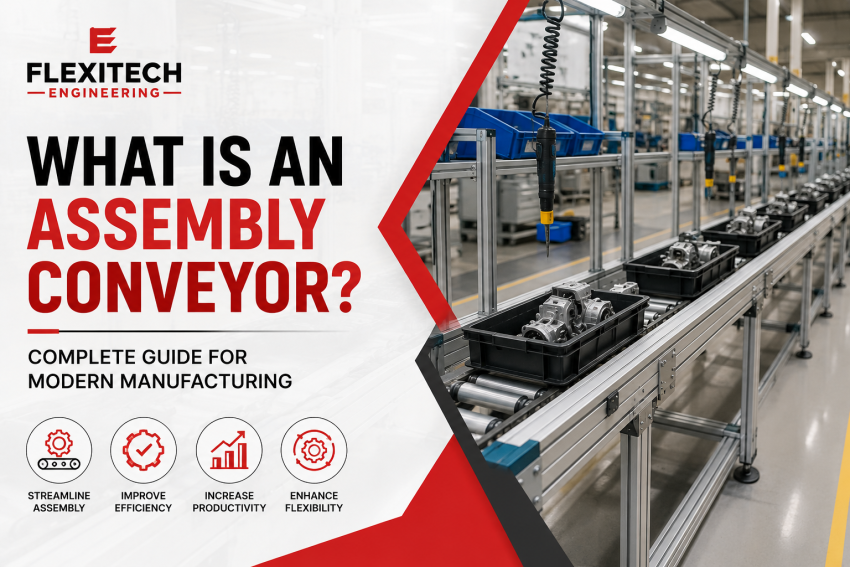
Modern manufacturing is no longer about isolated workstations and manual movement of goods from one station to another. Today’s production floors are built around efficiency, speed, and precision — and at the heart of this transformation is the assembly conveyor. Whether you’re running an automotive plant, an electronics factory, or a food packaging unit, assembly conveyors are the backbone of your production line.
In this comprehensive guide, we’ll walk you through everything you need to know about assembly conveyors — from their basic definition to their types, components, benefits, and how to choose the right one for your facility.
What Is an Assembly Conveyor?
An assembly conveyor is a mechanized system used in manufacturing environments to move products, components, or subassemblies from one workstation to another in a continuous, controlled, and sequential manner. Unlike simple transport conveyors that only move finished goods, assembly conveyors are specifically designed to allow workers or automated machines to perform tasks on a product while it is in motion or while it is temporarily stopped at designated stations.
Think of it as a moving production line — one that keeps everything flowing in sync, minimizes downtime, and ensures that each step in the manufacturing process is completed in the correct order and at the right time.
The concept was famously pioneered by Henry Ford in the early 20th century with his moving assembly line for automobile manufacturing. Today, assembly conveyors have evolved far beyond simple belt systems and now incorporate advanced automation, smart sensors, and precision control systems.
How Does an Assembly Conveyor Work?
At its core, an assembly conveyor works by continuously or intermittently moving a product along a defined path. Here’s a simplified breakdown of the process:
- Loading — A product or component is placed onto the conveyor at the starting point (often called the feed end).
- Movement — The conveyor moves the product at a controlled speed toward the next station.
- Assembly or Processing — At each workstation, either a human operator or an automated machine performs a specific task — such as inserting a part, tightening a bolt, applying a coating, or performing a quality check.
- Advancement — Once the task is complete, the conveyor advances the product to the next station.
- Unloading — At the end of the line, the finished product is removed, inspected, and sent to packaging or shipping.
The speed and timing of the conveyor can be adjusted based on the complexity of tasks at each station, ensuring that no workstation is overloaded or left idle.
Types of Assembly Conveyors
There is no one-size-fits-all solution in assembly conveyor systems. Different manufacturing environments require different types of conveyors. Here are the most commonly used types:
1. Belt Conveyors
Belt conveyors are the most traditional and widely recognized type. They use a continuous flat belt made from rubber, fabric, or synthetic materials to transport products. They are ideal for lightweight to medium-weight products and are commonly used in electronics, food processing, and light manufacturing industries.
Best for: Flat, stable products; simple linear assembly processes.
2. Roller Conveyors
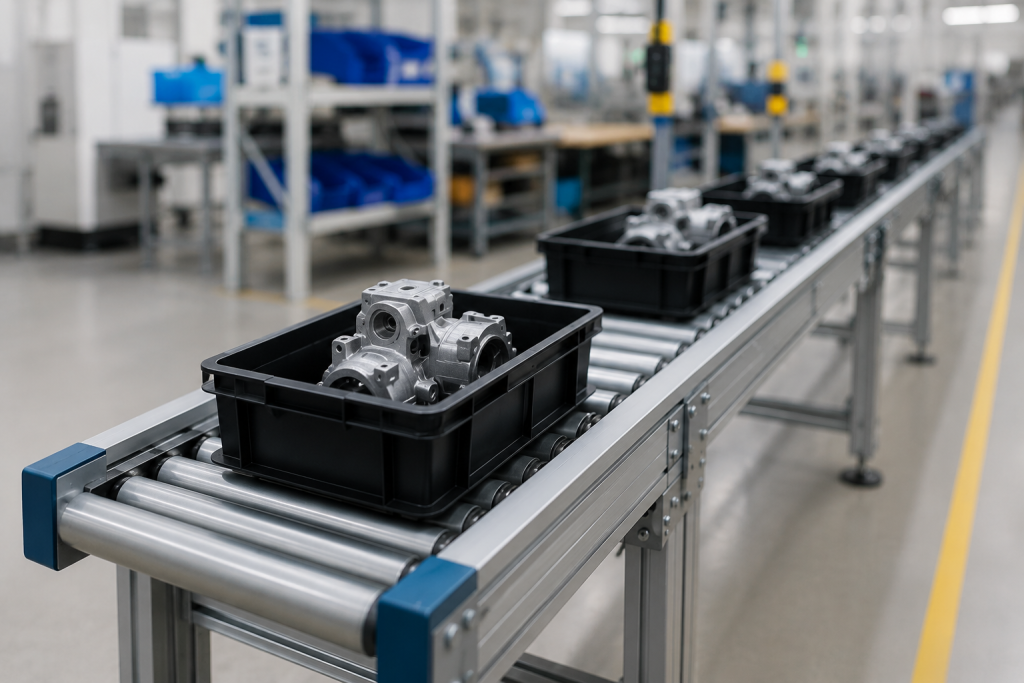
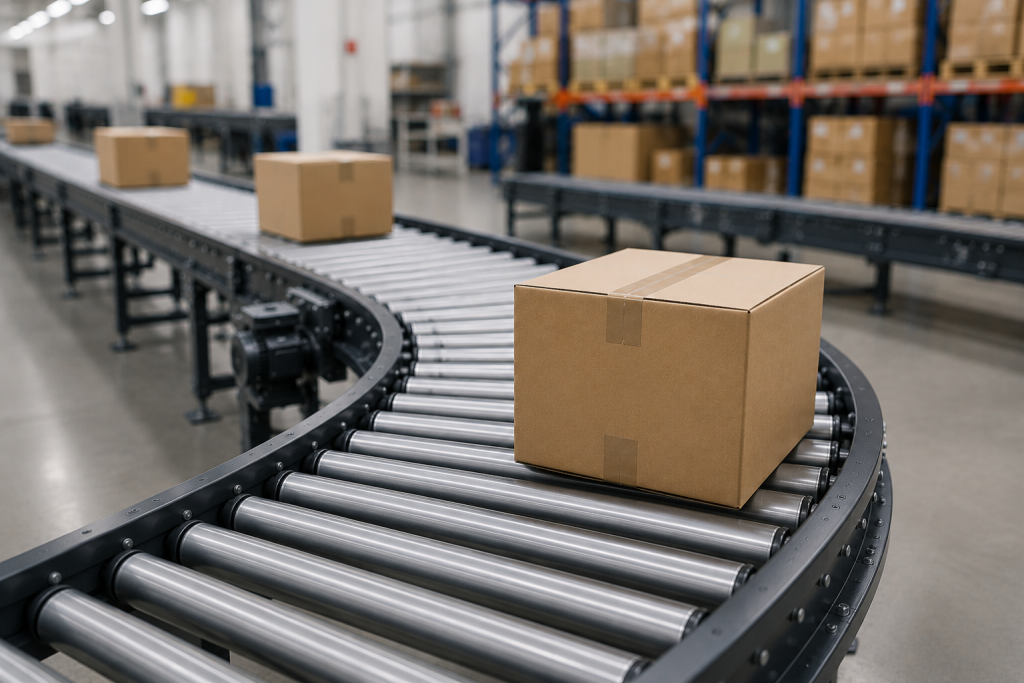
Roller conveyors use a series of rotating cylindrical rollers to move products. They can be powered (driven by a motor) or gravity-fed (using a slight incline). These are especially useful for heavier products and allow workers to easily stop items at individual stations.
Best for: Heavy components, pallets, boxes, and products requiring manual workstation stops.
3. Overhead/Inverted Conveyors
Also known as overhead chain conveyors or power-and-free conveyors, these systems suspend products from above using hooks or carriers. They free up floor space and are perfect for finishing processes like painting, coating, or drying.
Best for: Automotive manufacturing, surface finishing, and large product assembly.
4. Indexing Conveyors
Indexing conveyors move products in precise, step-by-step increments rather than continuously. The product stops at each station for a set duration, allowing workers or machines to complete tasks without the product moving. Once the task is done, it indexes (moves) to the next station.
Best for: High-precision assembly, electronics, and medical device manufacturing.
5. Pallet Conveyors
Pallet conveyors are designed to carry heavy product carriers (pallets) through multiple assembly stations. They offer flexibility because the pallet can be diverted, rotated, or held independently at each station.
Best for: Heavy machinery assembly, engine building, and complex multi-step manufacturing.
6. Flexible/Modular Conveyors
Modular Flexible conveyors are made of interlocking plastic or metal links, allowing the system to be reconfigured into different shapes and layouts as needed. They offer great versatility for manufacturers who frequently change their production line configurations.
Best for: Fast-changing product lines, seasonal manufacturing, and facilities that need layout flexibility.
Key Components of an Assembly Conveyor System
Understanding what makes up a conveyor system helps manufacturers make better decisions during procurement and maintenance. The core components include:
Drive System
The drive system — typically an electric motor paired with a gearbox and belt or chain drive — powers the entire conveyor. Variable frequency drives (VFDs) allow operators to adjust conveyor speed with precision.
Frame and Structure
The conveyor frame is usually made from aluminum extrusion or steel and provides the structural backbone of the entire system. The frame design determines the load capacity, durability, and ease of installation.
Conveying Surface
This is the actual surface that carries the product — be it a belt, rollers, slats, chains, or pallets. The choice of conveying surface depends on the weight, size, and nature of the product being assembled.
Workstation Fixtures
These are custom-built attachments at each station that hold, orient, or position the product correctly for the assembly task. Fixtures ensure repeatability and precision across thousands of production cycles.
Control System (PLC/HMI)
Modern assembly conveyors are controlled by Programmable Logic Controllers (PLCs) that manage speed, indexing, start/stop functions, and integration with other machines. An HMI (Human-Machine Interface) panel allows operators to monitor and control the line in real time.
Safety Systems
Safety light curtains, emergency stop buttons, guarding, and interlocks are essential components that protect operators and equipment from accidents.
Benefits of Using Assembly Conveyors in Manufacturing
The adoption of assembly conveyor systems delivers measurable advantages across multiple dimensions of manufacturing performance:
Increased Productivity
By eliminating manual product handling between stations, assembly conveyors significantly reduce non-value-added time. Workers spend more time performing productive assembly tasks and less time walking, waiting, or repositioning products.
Consistent Quality
Conveyors enforce a standardized workflow. Every product follows the same path, stops at the same stations, and is processed in the same sequence. This consistency dramatically reduces the risk of missed steps and human error.
Scalable Output
Manufacturers can ramp up production by simply increasing conveyor speed or adding stations. Conveyors are inherently scalable, making it easy to meet growing demand without major facility overhauls.
Reduced Labor Costs
Automation integration with conveyors — such as robotic arms, automated screwdrivers, and vision inspection systems — reduces the need for manual labor, lowering long-term operational costs.
Better Workflow Visibility
With modern sensors and monitoring software, managers can track production speed, identify bottlenecks, and measure output in real time. This data-driven visibility supports continuous improvement initiatives like Lean Manufacturing and Six Sigma.
Common Applications Across Industries
Assembly conveyors are used across virtually every manufacturing sector:
- Automotive — Engine assembly, seat installation, door panel fitting, and final vehicle assembly.
- Electronics — PCB assembly, smartphone manufacturing, and consumer electronics production.
- Food & Beverage — Packaging lines, bottle filling, labeling, and inspection.
- Medical Devices — Precision assembly of surgical instruments, diagnostic devices, and implants.
- Appliance Manufacturing — Washing machines, refrigerators, and HVAC units.
- Aerospace — Sub-assembly of aircraft components requiring high precision and traceability.
How to Choose the Right Assembly Conveyor
Selecting the right conveyor system is a critical decision that affects production efficiency, safety, and return on investment. Here are the key factors to evaluate:
Product Weight and Dimensions
Understand the maximum weight and physical dimensions of your product. This determines the type of conveyor surface, frame material, and drive capacity required.
Production Speed Requirements
How many units per hour do you need to produce? This defines the conveyor speed and the length of time allotted for each workstation.
Manual vs. Automated Stations
If your line is heavily manual, indexing conveyors that stop the product at each station work better. If you’re running a fully automated line, continuous belt or pallet conveyors are more appropriate.
Floor Space and Layout
Consider the available floor space and the required conveyor layout — straight, L-shaped, U-shaped, or custom. Overhead conveyors can be a smart solution when floor space is limited.
Future Scalability
Choose a system that can grow with your business. Modular conveyor systems offer the best flexibility for future expansion or product changeovers.
Budget and ROI
While initial investment matters, focus on total cost of ownership — including maintenance, energy consumption, spare parts availability, and productivity gains. A higher upfront investment in a quality system often pays off significantly over time.
Assembly Conveyors and Industry 4.0
The rise of Industry 4.0 — the fourth industrial revolution — has transformed assembly conveyors from simple mechanical systems into intelligent, connected production assets. Modern conveyor systems now integrate with:
- IoT sensors that monitor belt tension, motor temperature, and product position in real time.
- AI-powered vision systems that perform quality inspection on the fly.
- ERP and MES software for seamless production planning and tracking.
- Predictive maintenance platforms that alert maintenance teams before a breakdown occurs.
This connectivity makes assembly conveyors a critical node in the smart factory ecosystem, enabling manufacturers to achieve unprecedented levels of efficiency, traceability, and flexibility.
Conclusion
An assembly conveyor is far more than just a moving belt. It is the central nervous system of a modern manufacturing operation — one that connects people, machines, processes, and data into a synchronized production flow. Whether you’re a small manufacturer looking to streamline a manual line or a large enterprise building a fully automated smart factory, the right assembly conveyor system can be a game-changing investment.
As manufacturing continues to evolve with advances in automation and digitalization, assembly conveyors will remain at the forefront — continuously adapting to deliver greater speed, precision, and efficiency on the production floor.