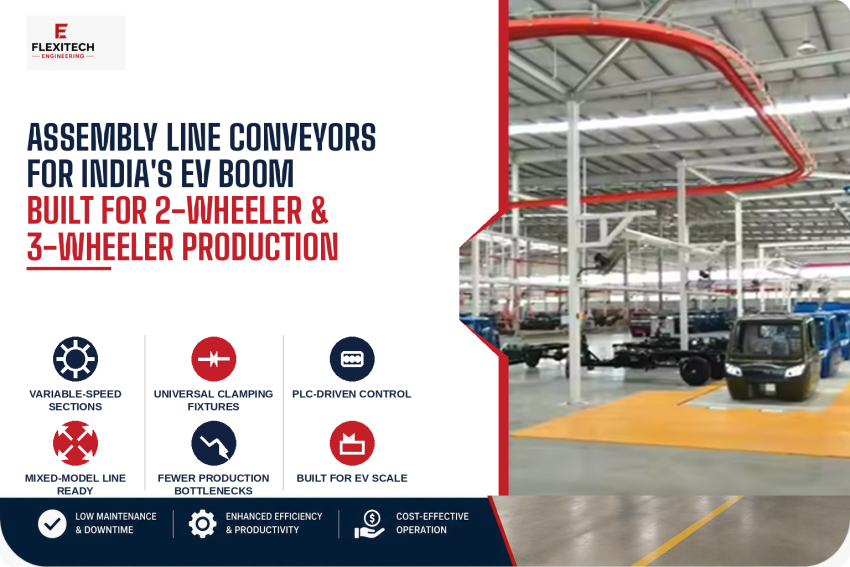
Nobody in the material handling business saw this coming quite so fast. One year, a plant is turning out a few hundred two-wheelers a month on a line built in the early 2010s. The next, the same shed is trying to squeeze out triple the volume, add a battery-pack station nobody had before, and somehow keep the whole thing running without falling apart at the seams. That’s the EV story playing out across Indian manufacturing hubs right now, and the conveyor sitting underneath it all is quietly taking the brunt of the pressure.
It’s easy to talk about EVs in terms of batteries, motors, and range anxiety. What gets less airtime is the unglamorous backbone that actually moves a vehicle from bare chassis to showroom-ready: the assembly line itself. And that backbone is buckling in more plants than most people would admit.
The Old Line Wasn’t Built for This
Here’s the thing about a conventional two-wheeler or three-wheeler line: it was designed around a fixed product, fixed weight, fixed cycle time. Swap in an EV drivetrain, and suddenly the assumptions don’t hold. Battery packs are heavier and more delicate than a fuel tank. Some stations now need anti-static surfaces to protect sensitive electronics. Cycle times shift because a technician torquing down a battery mount just doesn’t move at the same clip as one bolting on a carburetor.
Try running that mismatch on a conveyor that was never meant to flex, and something gives. Usually it’s throughput. Sometimes it’s the equipment itself, groaning under loads it wasn’t spec’d for.
A Quick Story From the Floor
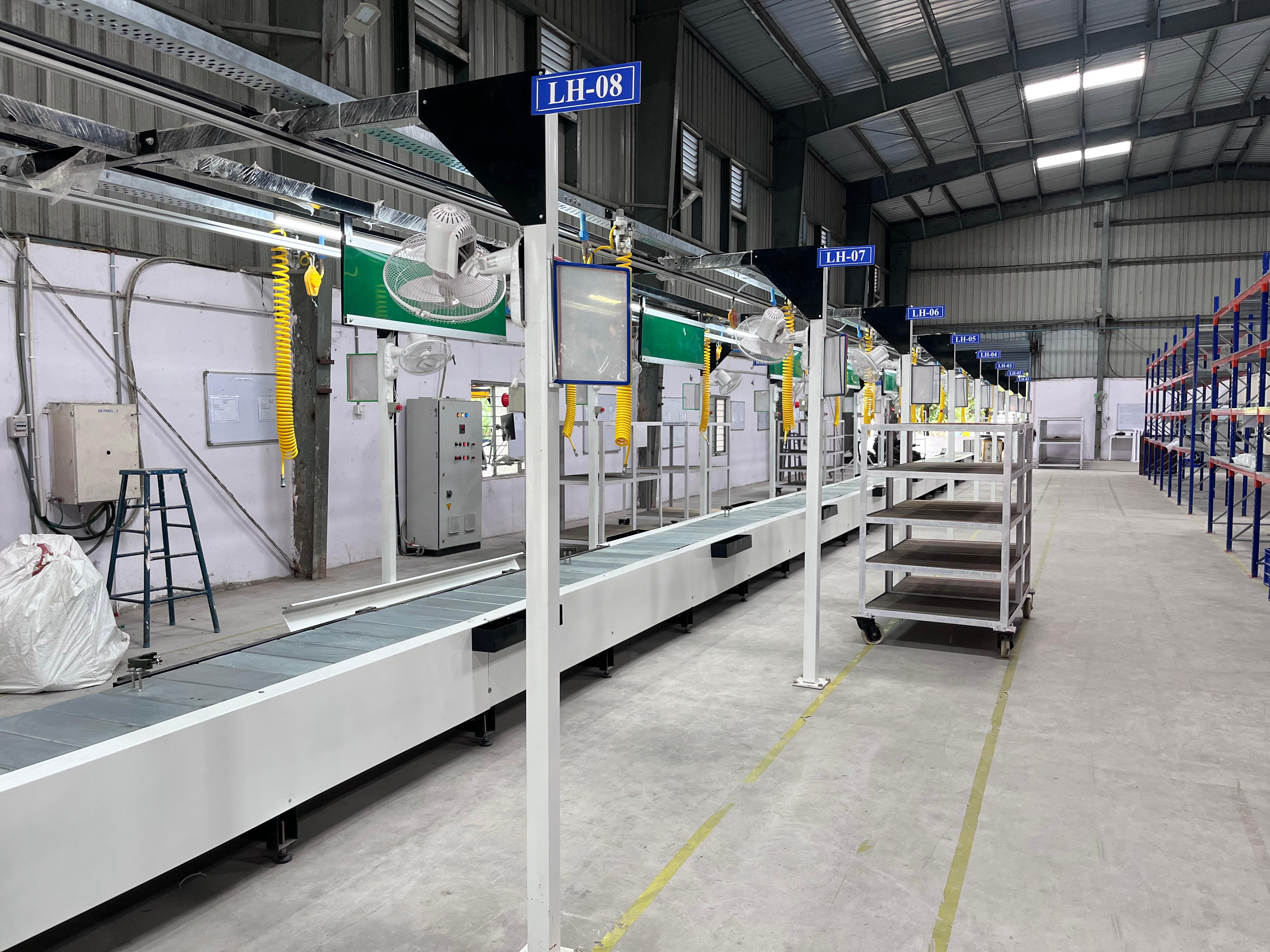
Picture a mid-sized plant outside Pune, one that spent a decade churning out petrol scooters without a hitch. Then the order books started filling up with EV variants. The existing two wheeler assembly line choked almost immediately – not because the workers were slower, but because the fixtures didn’t hold the battery trays right, and the conveyor’s fixed speed left the battery-testing station either starved for parts or drowning in a backlog. Within six weeks, they were losing production days to a bottleneck nobody had budgeted for. It’s a familiar tale in the industry these days, and it’s exactly why so many plants are going back to the drawing board on their conveyor setup instead of just patching the old one.
Two-Wheeler Lines Are Getting a Serious Rethink
For manufacturers retooling their two wheeler assembly line, the changes tend to cluster around a few things: variable-speed sections that can slow down for battery installation without dragging the whole line, universal clamping fixtures that handle both petrol and electric frames without a full changeover, and HMI displays so operators actually know what’s coming down the belt next. None of this is flashy. It’s practical, almost boring engineering – but it’s the difference between a plant that scales with demand and one that stalls out chasing it.
Three-Wheelers Bring Their Own Headaches
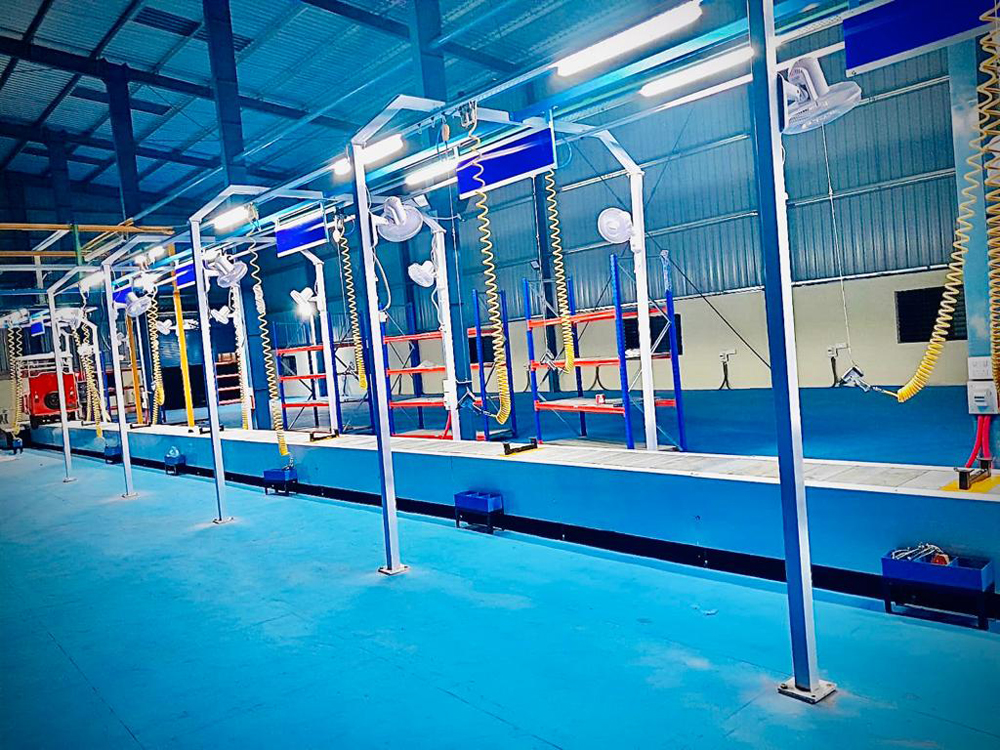
If two-wheelers are a puzzle, three-wheelers are a whole different animal. A three wheeler assembly line has to handle bulkier chassis, heavier payloads, and – in the case of e-rickshaws and cargo variants – a much wider range of configurations rolling down the same line. One day it’s a passenger model, the next it’s a loading variant with a completely different rear structure.
That kind of variability doesn’t sit well with rigid, single-purpose conveyors. What tends to work instead is a line built around universal vehicle-clamping fixtures, PLC-driven control so the system can reconfigure itself between vehicle types, and turntables or manipulators at key stations to give workers a fighting chance with awkward, heavy components. It’s not cheap to build this way. But compare that upfront cost against a line that grinds to a halt every time the order mix changes, and the math tends to work out just fine.
What to Actually Look for in a Manufacturer
This is where a lot of plant managers get stuck. Everyone claims to build assembly line conveyor systems, but not everyone has actually wrestled with the specific mess that EV retrofits create. A few things worth checking before signing anything:
Track Record With Mixed-Model Lines
Ask directly: has this manufacturer built a line that runs petrol and electric variants side by side, or handles multiple vehicle configurations without a full rebuild? If the answer is vague, that’s a red flag, not a maybe.
In-House Design and Manufacturing
Outsourced components mean longer lead times and more finger-pointing when something doesn’t fit right. A manufacturer that designs, builds, and installs under one roof tends to solve problems faster, because there’s nobody else to blame.
Willingness to Customize, Not Just Sell a Catalog Item
EV assembly isn’t a plug-and-play situation. A good assembly line conveyor manufacturer in india will walk the floor, watch the actual production rhythm, and build around it – rather than handing over a standard-issue conveyor and calling it a day.
After-Sales Support That Doesn’t Disappear
Once the line is running, things shift: new product variants, layout tweaks, unexpected wear. A manufacturer who ghosts after installation leaves a plant stranded exactly when flexibility matters most.
Where This Is Headed
The EV push in India isn’t slowing down, and neither is the pressure on the equipment underneath it. Plants that treat their conveyor as an afterthought – something to patch up rather than rethink – are going to keep losing days to bottlenecks that were entirely avoidable. The ones getting ahead of it are the ones asking harder questions upfront: not just “can this conveyor move parts,” but “can this conveyor move parts profitably, at scale, through a product mix that keeps changing.”
That’s not a small ask. But it’s the ask that separates a line built for last decade’s vehicles from one that’s actually ready for what’s coming next.
Frequently Asked Questions
Q: Why can’t an existing petrol vehicle assembly line just be adapted for EVs?
It often can be, partially – but battery weight, anti-static requirements, and different cycle times usually expose weaknesses in fixtures, speed control, and station layout that a straight adaptation can’t fully solve.
Q: What’s the biggest bottleneck plants run into when switching to EV production?
Battery installation and testing stations are the most common culprits. They typically need more dwell time than a fuel-based equivalent, which throws off the pacing of the entire line if the conveyor can’t flex around it.
Q: Is it worth building a line that handles both petrol and electric variants together?
For many manufacturers, yes – especially during the transition period when demand for both is still active. A mixed-model line with universal fixtures and PLC control avoids the cost of running two separate setups.