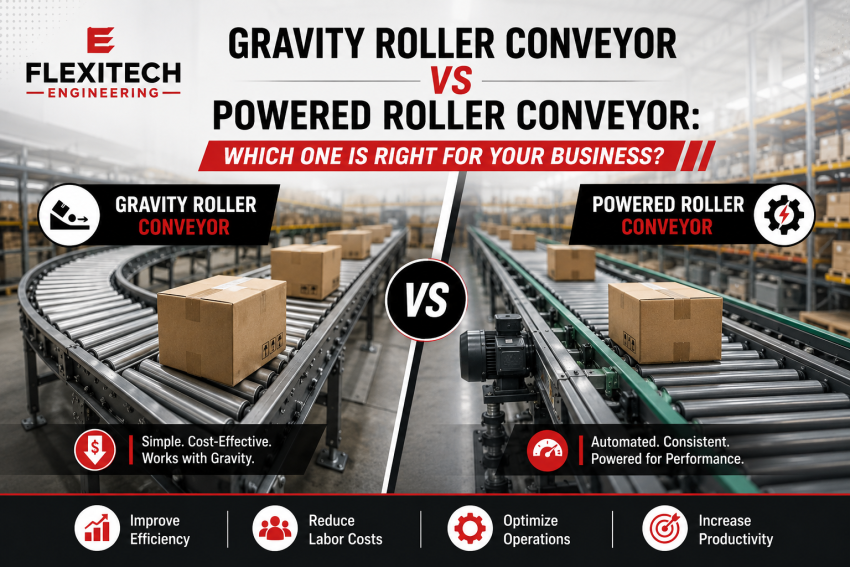
In today’s competitive industrial landscape, selecting the right material handling equipment is crucial for efficiency and cost savings. Two of the most widely used systems are Gravity Roller Conveyor and Powered Roller Conveyor. While both use rollers to transport goods, their working principles, applications, and benefits differ significantly.
This comprehensive comparison will help you understand the key differences, advantages, limitations, and ideal use cases. At the end, we will also discuss why Flexitech Engineering stands out among leading roller conveyor manufacturers in India.
What is a Gravity Roller Conveyor?
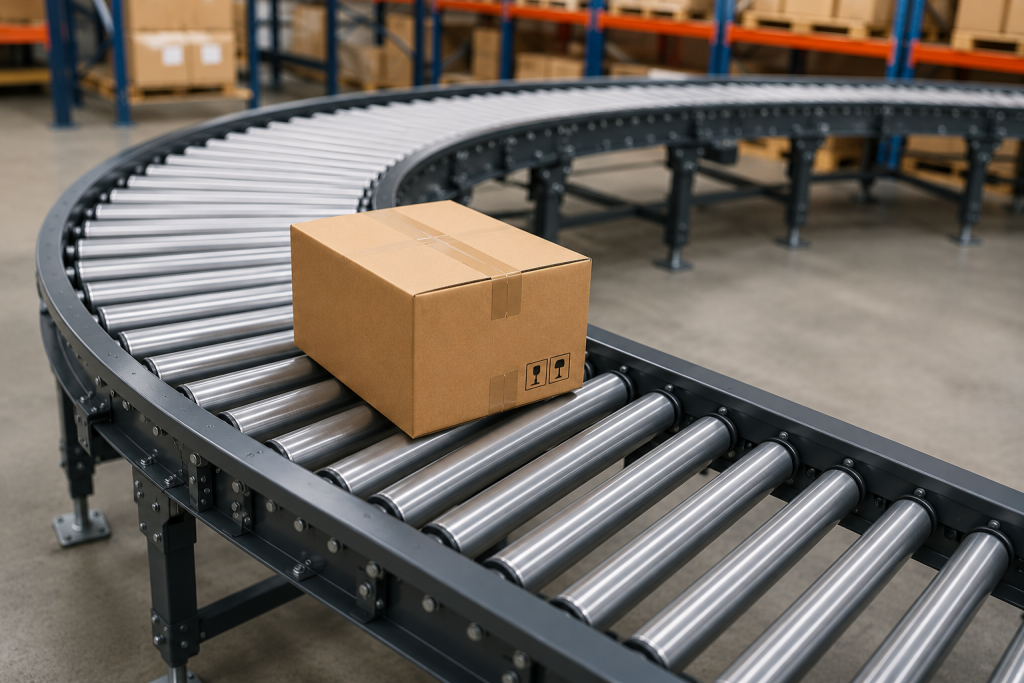
A Gravity Roller Conveyor is a non-powered system that relies on gravity to move products. The conveyor is installed at a slight decline (usually 2-5 degrees), allowing items to roll naturally from higher to lower points. It requires no electricity, motors, or complex controls.
Main Features:
- Simple and sturdy design
- Low maintenance
- Cost-effective
- Easy to install and modify
These systems are ideal for short-distance movement where products have sufficient weight to flow on their own.
What is a Powered Roller Conveyor?
A Powered Roller Conveyor (also called Live Roller Conveyor) uses electric motors to drive the rollers. This provides consistent movement even on flat surfaces or slight inclines. Power can be delivered through belt drive, chain drive, or modern Motor Driven Rollers (MDR).
Main Features:
- Precise speed control
- Ability to handle inclines and long distances
- Advanced accumulation and zoning options
- Integration with automation systems
Powered systems are preferred in high-speed, automated environments.
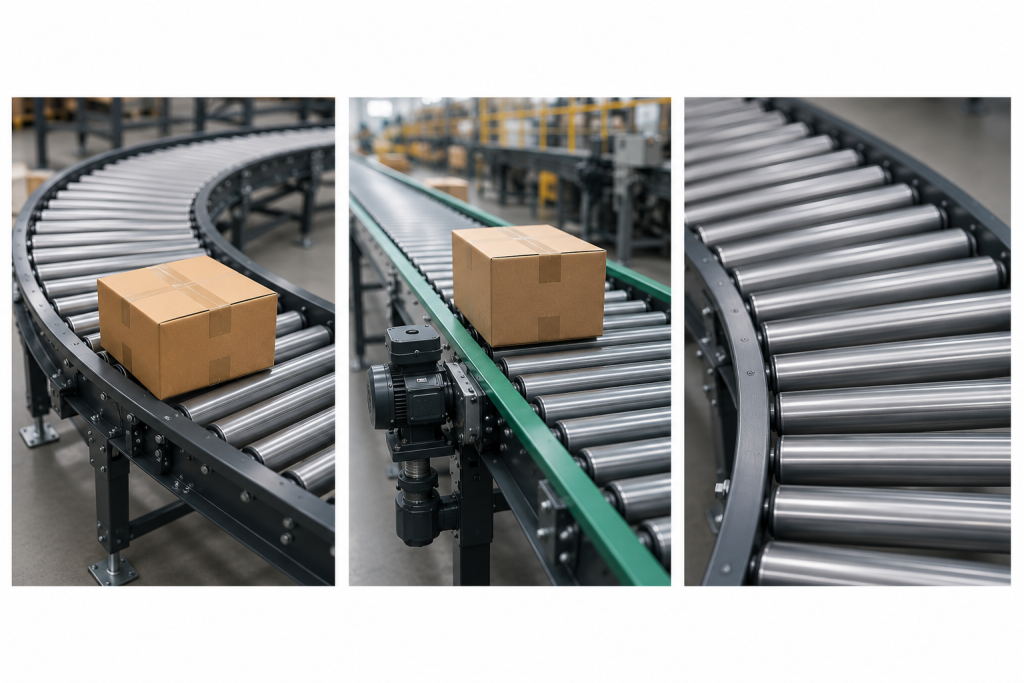
Key Differences: Gravity Roller vs Powered Roller
| Parameter | Gravity Roller Conveyor | Powered Roller Conveyor |
| Power Requirement | None (Gravity-based) | Electric motors required |
| Movement Control | Limited | Excellent (speed, direction, zoning) |
| Best For | Downhill, short distance | Long distance, flat, incline |
| Initial Cost | Lower | Higher |
| Operating Cost | Very low | Moderate (energy consumption) |
| Maintenance | Minimal | Moderate |
| Throughput | Low to medium | High |
Advantages and Disadvantages
Gravity Roller Conveyor Advantages:
- Very low purchase and running cost
- No electricity needed – highly energy efficient
- Quiet operation
- Easy to expand or reconfigure
- Perfect for warehouses and packing areas
Limitations:
- Only works downhill or with manual push
- Less control over product flow
- Not suitable for light or uneven packages
- Cannot move items uphill
Powered Roller Conveyor Advantages:
- Consistent performance regardless of load weight
- Can transport over long distances and inclines
- Better product accumulation without pressure
- Suitable for automated lines and sorting
- Higher productivity in busy facilities
Limitations:
- Higher initial investment
- Requires power supply and periodic maintenance
- More complex installation
Best Applications
Gravity Roller Conveyors work excellently in:
- Order picking and packing stations
- Shipping and receiving areas
- Warehouse flow racks
- Assembly lines with natural downward flow
- Low-volume operations
Powered Roller Conveyors are ideal for:
- E-commerce fulfillment centers
- Manufacturing and assembly lines
- Food processing and packaging
- Automotive and logistics hubs
- High-throughput distribution centers
Many facilities use hybrid systems – combining gravity sections for simple movement and powered sections for critical control points.
Cost Comparison
Gravity roller systems are generally 40-60% cheaper upfront. However, in high-volume operations, powered roller conveyors often deliver better long-term ROI through labor savings, reduced product damage, and increased speed.
Factors to Consider Before Choosing
- Type and weight of products
- Layout and distance of material flow
- Required speed and throughput
- Available budget
- Future expansion plans
- Level of automation needed
Why Choose Flexitech Engineering as Your Conveyor Partner?
When selecting between gravity and powered roller systems, working with experienced roller conveyor manufacturers makes a big difference. Flexitech Engineering, based in Ghaziabad, Uttar Pradesh, is a trusted name among Indian industries for reliable material handling solutions.
Flexitech Engineering specializes in both Gravity Roller Conveyors and Powered Roller Conveyors, offering customized systems tailored to your exact requirements. Here’s why many businesses prefer them:
- High-Quality Build: Robust frames, precision rollers, and durable components suitable for Indian working conditions.
- Advanced Powered Systems: Their powered roller conveyors come with modern features like VFD controls, zero-pressure accumulation, sensors, and PLC integration.
- Customization: From standard gravity lines to fully automated powered setups, they design solutions as per your facility layout.
- Complete Support: Design, manufacturing, installation, and after-sales service under one roof.
- Industry Experience: Serving manufacturing, warehousing, food processing, automotive, and logistics sectors effectively.
- Cost-Effective Solutions: Competitive pricing with long-term performance and low maintenance.
Whether you need a simple gravity roller conveyor for basic movement or a sophisticated powered roller conveyor for automated operations, Flexitech Engineering delivers systems that improve efficiency and reduce operational headaches.
Their expertise as one of the dependable conveyor systems providers in India ensures you get future-ready solutions that grow with your business.
Conclusion
Both Gravity Roller Conveyors and Powered Roller Conveyors have their own strengths. Gravity systems are best for simple, low-cost applications, while powered systems excel in complex, high-speed environments. The right choice depends on your specific operational needs, layout, and growth plans.
For businesses looking for reliable performance, durability, and expert guidance, partnering with a reputed manufacturer like Flexitech Engineering ensures you get the best value from your investment.
If you are planning to install or upgrade your material handling system, contact Flexitech Engineering today. Their team will analyze your requirements and recommend the most suitable gravity roller or powered roller conveyor solution for maximum productivity.