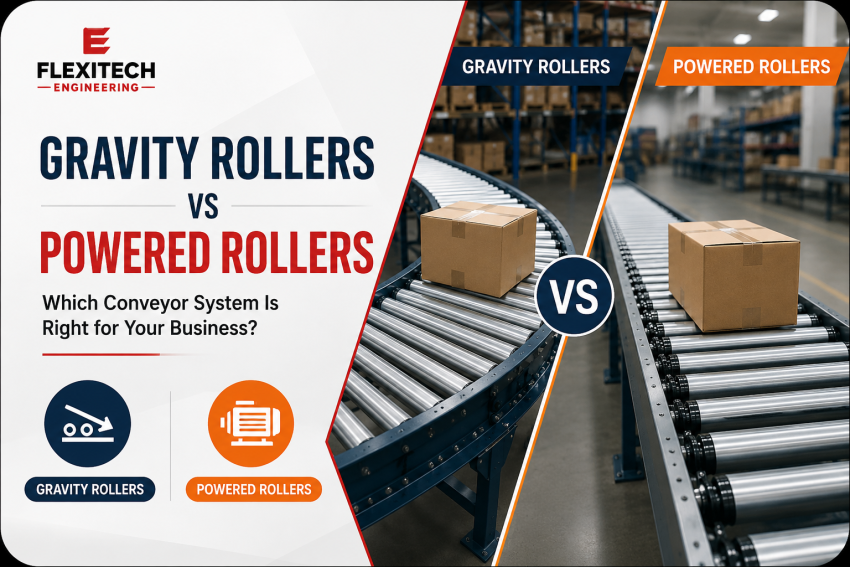
When it comes to material handling and industrial conveyor systems, one of the most fundamental decisions a business must make is choosing between gravity rollers and powered rollers. Both systems have their place in modern warehouses, manufacturing plants, and distribution centres — but selecting the wrong one can lead to inefficiencies, increased costs, and operational bottlenecks.
This comprehensive guide breaks down the key differences between gravity roller conveyors and powered roller conveyors, covering their working mechanisms, ideal applications, pros and cons, and cost considerations — so you can make an informed decision for your facility.
What Is a Gravity Roller Conveyor?
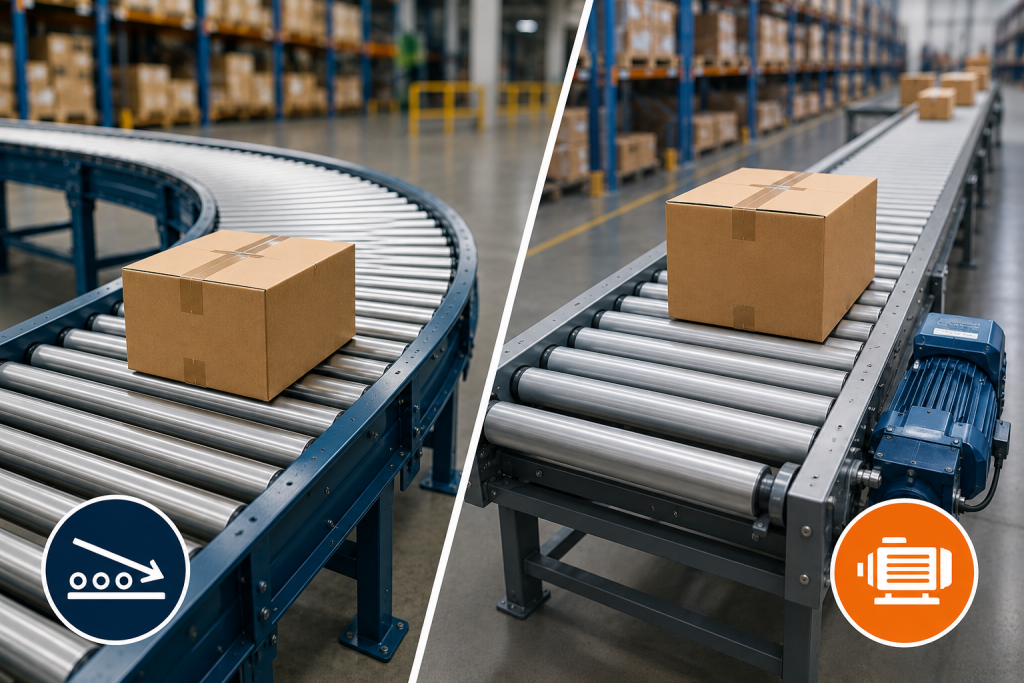
A gravity roller conveyor is a passive material handling system that uses the natural force of gravity — and sometimes a slight incline — to move goods from one point to another. The rollers are free-spinning, meaning they rotate when an object is placed on them and given a push. No motor, no electricity, no complex control system.
These conveyors are typically made from steel or aluminium frames with cylindrical rollers mounted at regular intervals. The spacing between rollers depends on the size and weight of the items being transported.
How Gravity Rollers Work
Gravity conveyors rely on one of two principles:
- Inclined Flow: The conveyor is set at a downward angle so products slide along under their own weight.
- Manual Push: On flat sections, a worker gives the item a push to keep it moving.
These systems are most effective in loading docks, packaging lines, and order picking zones where items are manually handled and controlled movement is acceptable.
What Is a Powered Roller Conveyor?
A powered roller conveyor (also called a motorised or live roller conveyor) uses electric motors to drive the rollers, moving products along the conveyor automatically — regardless of incline or manual input. These systems are the backbone of high-throughput, automated production and distribution environments.
Powered rollers can be driven by a central belt, a chain-driven mechanism, or individually via 24V DC motorised rollers (MDRs). Each method offers different levels of control, noise, and energy efficiency.
Types of Powered Roller Drives
- Belt-Driven Live Roller (BDLR): A flat belt runs beneath the rollers, turning them via friction. Simple and cost-effective.
- Chain-Driven Live Roller (CDLR): Heavy-duty option for pallets and dense loads. More robust but noisier.
- Motorised Drive Roller (MDR): Each zone has its own 24V motor. Highly energy efficient and ideal for zero-pressure accumulation.
Key Differences: Gravity Rollers vs Powered Rollers
Understanding the core distinctions between the two systems helps clarify which one suits your operational needs.
1. Power Source and Energy Consumption
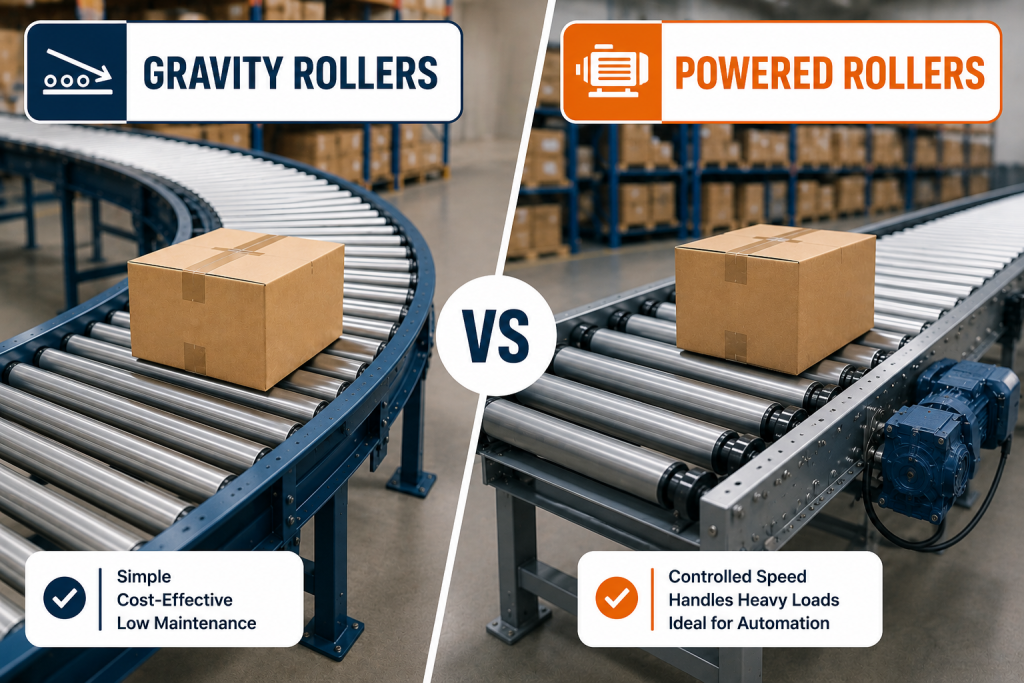
Gravity rollers require zero electricity. Their entire operation depends on physics — slope and manual effort. This makes them extremely cost-efficient to run. Powered rollers, on the other hand, require a constant power supply. However, modern MDR systems are designed to consume energy only when a product is present in a zone, significantly reducing overall energy usage compared to older continuous-drive systems.
2. Speed and Throughput
Powered rollers win decisively when it comes to speed and volume. They can move products at consistent, controlled speeds — often programmable — without relying on gravity or human assistance. Gravity conveyors are limited by slope angle and manual handling, making them suitable for low-to-medium throughput environments only.
3. Installation and Maintenance
Gravity roller systems are simpler to install, easier to maintain, and can often be reconfigured or extended without specialist engineers. Powered systems require electrical infrastructure, motor servicing, and more complex commissioning. However, the reliability of modern motorised rollers has improved dramatically, and MDR systems in particular have very low maintenance requirements.
4. Control and Automation
Powered rollers integrate seamlessly with warehouse management systems (WMS), sensors, PLCs, and automated sorting equipment. This makes them the go-to choice for modern automated warehouses. Gravity rollers, being entirely passive, offer no automation capability on their own — though they can be part of a hybrid system alongside powered sections.
5. Load Handling
Both systems can handle a wide range of weights, but their strengths differ. Gravity rollers are excellent for lighter cartons and boxes on picking lines. Chain-driven powered rollers are designed specifically for heavy loads like pallets, automotive components, and industrial containers — handling weights up to several tonnes per linear metre in some configurations.
Advantages of Gravity Roller Conveyors
- Zero energy cost — no electricity required for operation
- Low upfront investment and simple installation
- Minimal maintenance — no motors or drives to service
- Flexible and easily reconfigured for different layouts
- Quiet operation — no noise from motors or drives
- Suitable for inclined, decline, or flat-with-push configurations
Advantages of Powered Roller Conveyors
- Consistent, automated product movement without manual effort
- High throughput capability — ideal for large-scale operations
- Integrates with automation, sensors, and WMS software
- Can handle uphill, downhill, and level movement equally
- Programmable speed and zone control with MDR technology
- Zero-pressure accumulation prevents product damage
Common Applications: Where Each System Excels
Gravity Rollers — Best Used For:
- Loading docks and shipping/receiving areas
- Retail back-of-store product flow
- Manual order picking and packing stations
- Short conveyor runs where automation is not required
- Assembly lines with manual workstations
- Temporary or seasonal setups needing portable equipment
Powered Rollers — Best Used For:
- E-commerce fulfilment centres with high order volumes
- Automotive and heavy manufacturing assembly lines
- Airport baggage handling systems
- Food and beverage production lines
- Cold storage and refrigerated warehouse environments
- Pharmaceutical and electronics manufacturing with precision control needs
Cost Comparison: Initial Investment vs Long-Term Value
Cost is often the deciding factor — but it is important to look beyond the purchase price and consider the total cost of ownership (TCO).
Gravity Roller Conveyor Costs
Gravity conveyors are significantly less expensive upfront. A standard gravity roller section can cost a fraction of an equivalent powered unit. There are no electrical installation costs, no motor replacements, and ongoing maintenance is minimal — typically limited to occasional roller replacement. For small businesses or operations with limited budgets, gravity systems offer excellent ROI.
Powered Roller Conveyor Costs
Powered systems carry a higher initial investment due to motors, drives, controls, and electrical infrastructure. However, they dramatically reduce labour costs. In a high-volume warehouse where workers would otherwise be manually moving thousands of items per shift, a powered conveyor pays for itself within months. MDR systems also reduce energy bills significantly compared to older always-on belt drives.
When Does the Investment Make Sense?
Consider upgrading to powered rollers when:
- Labour costs exceed the cost of automation within 12–24 months
- Throughput requirements exceed what manual handling can support
- Product damage during manual transfer is causing losses
- You are integrating with automated sorting, scanning, or palletising systems
Which Conveyor System Should You Choose?
There is no single correct answer — the right system depends on your specific operational needs, budget, and long-term goals. Here is a practical decision framework:
Choose Gravity Rollers If…
- You are handling light-to-medium weight products (under 50 kg per item)
- Your throughput is low-to-moderate and manual oversight is available
- You need a cost-effective, easy-to-install solution quickly
- The application involves inclined or gravity-friendly product flow
- Automation integration is not a current requirement
Choose Powered Rollers If…
- You require consistent, high-speed product movement without manual labour
- You are building or upgrading an automated warehouse or production line
- You handle heavy, bulky, or irregularly shaped items
- Product flow needs to run horizontally, uphill, or along complex routes
- You need WMS or PLC integration for traceability and control
Can You Use Both Systems Together?
Absolutely — and many operations do. Hybrid conveyor systems combine gravity and powered sections strategically. For example, powered rollers might carry products through the main warehouse flow, while gravity sections at the end of the line feed products down to a packing station at no energy cost. This approach maximises efficiency while minimising operating expenses.
When designing a hybrid system, consult a material handling specialist to ensure smooth product transfers between powered and gravity zones, appropriate incline angles, and correct roller spacing throughout.
Why Choose Flexitech Engineering for Your Conveyor Needs?
At Flexitech Engineering, we are a trusted manufacturer and supplier of high-quality conveyor roller systems — including both gravity roller and powered roller solutions. With deep industry expertise and an in-house manufacturing setup, we design and deliver conveyor systems tailored to your specific application, load requirements, and facility layout.
Whether you are setting up a new production line, upgrading an existing warehouse, or looking for a cost-effective gravity solution for your loading dock, Flexitech Engineering provides end-to-end support — from system design and manufacturing to installation and after-sales service.
What sets us apart:
- In-house manufacturing ensures strict quality control and faster delivery timelines
- Custom-built conveyor systems designed around your operational requirements
- Wide range of gravity rollers, powered rollers, and hybrid conveyor configurations
- Competitive pricing with no compromise on durability or performance
- Dedicated technical support and after-sales service across industries
Reach out to the Flexitech Engineering team today to discuss your conveyor requirements and get a customised solution for your facility.
Final Thoughts
Both gravity rollers and powered rollers are proven, reliable solutions — each outstanding in the right context. Gravity conveyors offer unmatched simplicity and economy for lower-volume, budget-conscious operations. Powered rollers deliver the speed, control, and automation capability that high-demand modern facilities require.
Before making your final decision, assess your current throughput, future growth plans, product types, available floor space, and budget. If possible, speak with a conveyor system supplier who can survey your facility and recommend the optimal configuration — whether that is an all-gravity setup, a fully motorised line, or a cost-effective hybrid.
The right conveyor system is not just an equipment purchase — it is an investment in the long-term efficiency and scalability of your entire operation.