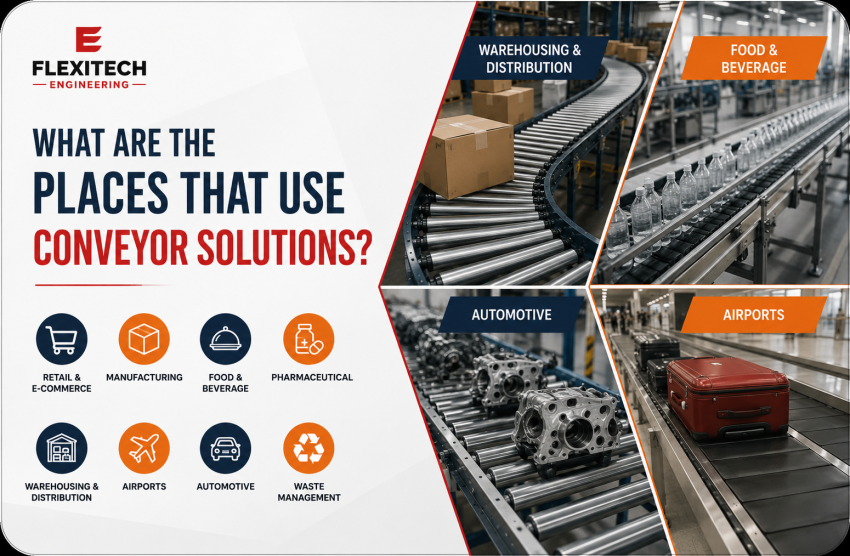
Conveyor systems have become a fundamental part of modern industry. From large-scale automotive plants to neighbourhood e-commerce warehouses, conveyors streamline the movement of goods, components, and materials — reducing manual handling, saving time, and improving overall productivity. But the real question many businesses and plant managers ask is: which industries and places actually rely on conveyor solutions, and what types are best suited for each application?
This blog explores the wide variety of sectors that depend on industrial conveyor systems and breaks down how each benefits from specific conveyor types — helping you understand where the right solution can make a measurable difference.
1. Automotive and Vehicle Manufacturing
The automotive industry is one of the largest users of conveyor systems worldwide, and for good reason. Assembling a car, two-wheeler, or three-wheeler involves hundreds of sequential steps, each requiring precise positioning, safe part movement, and ergonomic workstations for operators.
Two-Wheeler and Three-Wheeler Assembly
Motorcycle and scooter manufacturers rely heavily on Two Wheeler Assembly Conveyor lines that move vehicle frames through each stage of production — from chassis mounting to engine fitment to final inspection. Similarly, Three Wheeler Assembly Conveyor systems are designed with load-bearing capacity and pace control in mind, allowing manufacturers to maintain high throughput without compromising build quality.
ESD-Safe Assembly Environments
Electrical components used in vehicles — including circuit boards, sensors, and wiring harnesses — require electrostatic discharge protection during assembly. An ESD Workstation integrated within the conveyor line ensures operators can safely handle sensitive components without risking static damage. This is especially critical in electric vehicle (EV) manufacturing, where high-voltage battery packs are assembled.
2. Consumer Electronics and Appliance Manufacturing
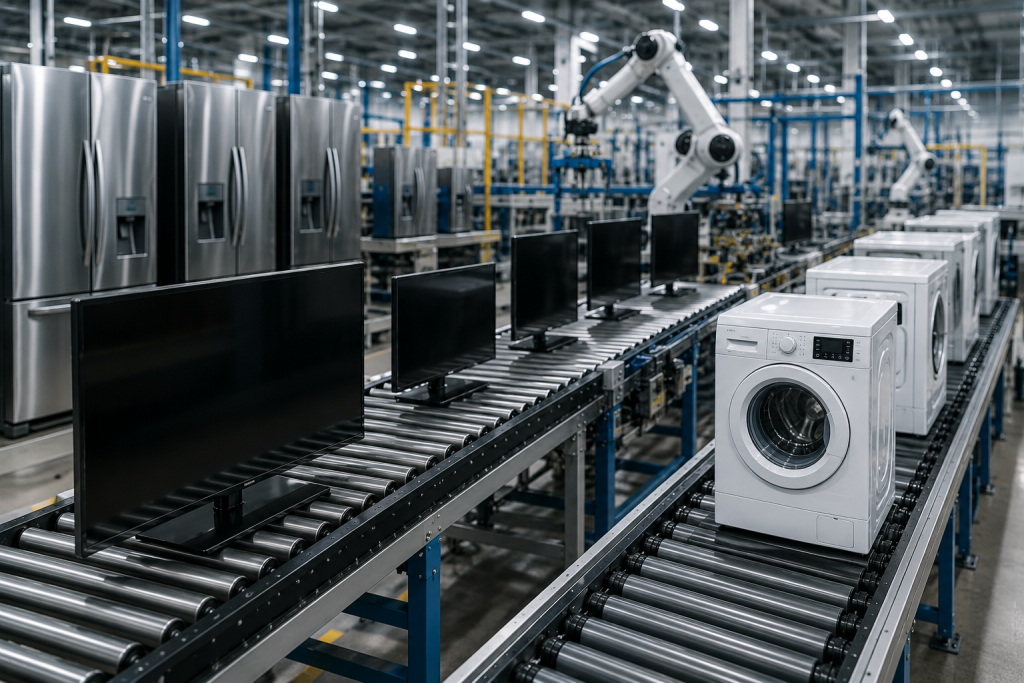
Consumer electronics factories produce millions of units annually. Managing the complex sub-assembly of products like televisions, refrigerators, and air conditioners requires both precision and speed — two qualities that modern conveyor systems deliver consistently.
LED TV and Home Appliance Lines
A LED TV Assembly Line typically uses flat belt conveyors combined with ESD-protected workstations to allow technicians to attach screens, connect components, and run QC tests in a linear, organised flow. For larger appliances, the Assembly Line for Refrigerator & Air Conditioning equipment uses heavier-duty conveyors capable of bearing the weight of compressors, condensers, and sheet metal housings — often with adjustable speeds to match varying assembly complexities.
Battery Assembly
With the rise of lithium-ion batteries for everything from smartphones to electric vehicles, dedicated Battery Assembly Line conveyors are becoming increasingly common. These require precise speed control, anti-static environments, and often cleanroom compatibility — making them among the most specialised conveyor applications in manufacturing today.
3. Warehousing, Logistics, and E-Commerce
The explosion of e-commerce has pushed warehousing and logistics facilities to adopt automated conveyor solutions at an unprecedented scale. Moving parcels, cartons, and packages from receiving docks to sorting areas to dispatch zones is a challenge that only mechanised handling can solve efficiently.
A Telescopic Conveyor is particularly popular in loading and unloading operations, extending into truck beds to allow faster, safer manual or automated loading without the need for additional equipment. Similarly, a Truck Loading Conveyor streamlines outbound logistics by mechanically feeding packages into vehicles, significantly cutting labour costs and loading time.
For vertical movement within multi-storey warehouses or mezzanine floors, a Vertical Conveyor & Goods Lift offers a safe and efficient alternative to forklifts or manual carrying. These systems are especially valued in facilities where floor space is at a premium and vertical storage is maximised.
In sorting and distribution centres, Modular Belt Conveyor systems handle sharp turns and inclines with ease, while Spiral Conveyor units manage continuous vertical elevation of products in compact footprints — ideal for connecting different floor levels without using ramps.
4. Food and Beverage Processing
Hygiene, speed, and durability are non-negotiable in food processing. Conveyor systems in this sector must comply with food-grade standards, withstand regular washdowns, and operate continuously across demanding production schedules.
Flat Belt Conveyor and Rubber Belt Conveyor systems are commonly found in food packaging lines, carrying items like bottles, pouches, biscuit packs, and canned goods from filling stations to sealing and labelling areas. Inclined Belt Conveyor variants are used when products must be elevated — for instance, moving packaged goods up to overhead packaging machines or elevated palletising stations.
Loose bulk materials like grains, spices, flour, and powders are often transported using a Pneumatic Conveying System, which uses air pressure or vacuum to move material through enclosed pipelines — eliminating contamination risk and reducing product spillage significantly.
5. Pharmaceutical and Healthcare Manufacturing
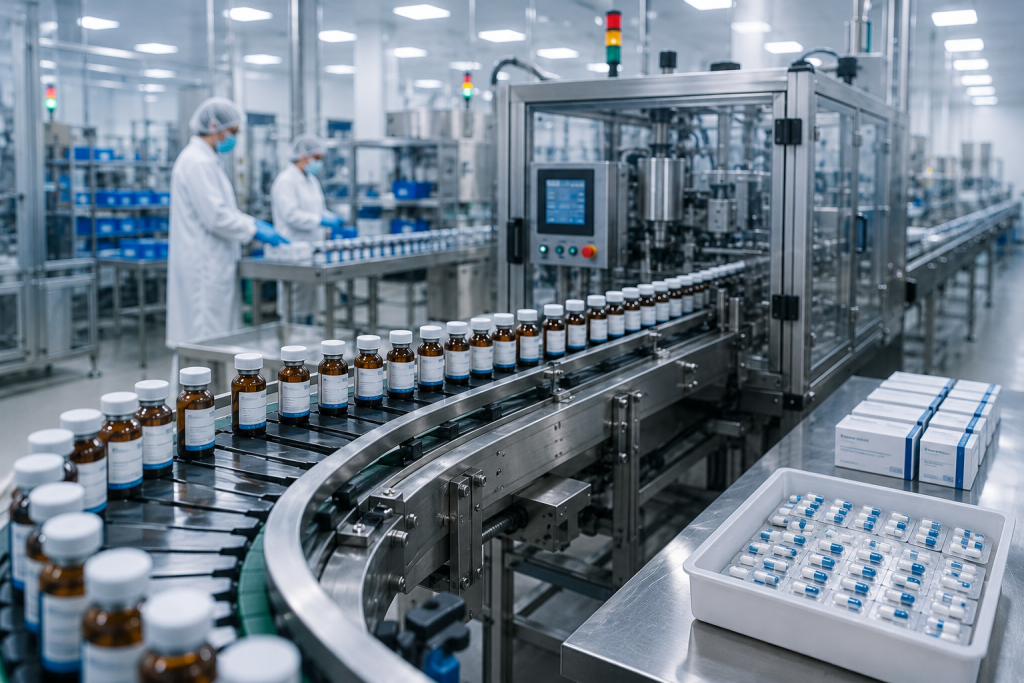
Pharmaceutical plants and healthcare product manufacturers demand the highest standards of cleanliness, precision, and traceability. Conveyor systems in these environments must be easy to sanitise, built from food-grade or pharmaceutical-grade materials, and compatible with automated inspection systems.
Modular belt conveyors and flat belt conveyors are widely used to transport vials, blister packs, syringes, and cartons across filling, packaging, and QC stations. Free Flow Conveyor systems are particularly useful in pharmaceutical assembly lines, where products must accumulate without back-pressure — allowing operators at individual stations to work at their own pace without halting the entire line.
6. Heavy Industry and Metal Fabrication
Steel plants, foundries, and metal fabrication units deal with extremely heavy and high-temperature materials that require heavy-duty conveyor solutions. Standard conveyor systems are often insufficient here — specialised equipment is essential.
A Slat Conveyor is a go-to choice in metal fabrication and automotive press shops, where heavy stamped parts, castings, or metal sheets need to be transported without damaging surfaces or causing jamming. Slat conveyors use rigid metal plates, making them capable of bearing significant loads and resisting heat.
SPM Machines (Special Purpose Machines) are custom-engineered systems designed for unique manufacturing requirements — often integrated with conveyor lines to automate tasks like drilling, riveting, or welding at specific stations. These are common in high-volume production environments where standard off-the-shelf equipment cannot meet output targets.
For parts movement within large production facilities, Overhead Conveyor systems make use of ceiling-mounted tracks to transport components across the factory floor without occupying valuable ground-level space. These are extensively used in automotive paint shops, garment factories, and metal treatment facilities.
7. Retail Distribution and FMCG
Fast-Moving Consumer Goods (FMCG) companies and retail distribution centres process thousands of SKUs daily. Efficient sortation, picking, and packing demand conveyor systems that can handle diverse product sizes, weights, and packaging types.
FIFO Racks and Joints (First-In, First-Out) are critical in FMCG warehousing to ensure stock rotation and prevent expiry of goods. These systems use gravity or powered rollers to maintain product flow in the correct sequence — particularly important for perishables and date-sensitive items.
A Gravity Roller Conveyor is a cost-effective, low-maintenance option commonly used in pick-and-pack stations, where operators manually move cartons along roller paths. For lines requiring motorised movement, a Powered Roller Conveyor takes over — automating box transportation between different zones of the warehouse without manual effort.
Where conveyor lines need to change direction, a Bend Roller Conveyor provides smooth 45- or 90-degree turns, maintaining product flow without manual redirection. And in tight or variable-layout spaces, a Flexible Conveyor can be repositioned as needed — invaluable in dynamic warehouse environments where layouts change frequently.
8. Agriculture and Mining
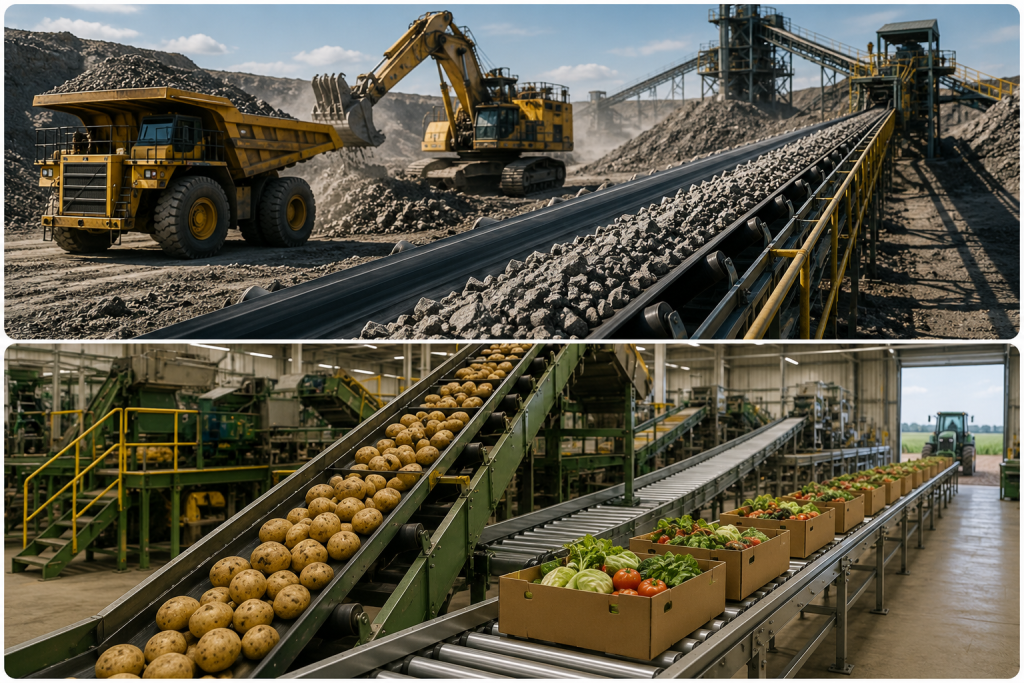
In agriculture and mining, bulk material handling is a constant challenge. Conveyor systems transport everything from harvested grain and vegetables to coal, sand, and ore across large distances with minimal labour.
Rubber Belt Conveyor systems are the workhorses of mining operations, built to handle sharp, heavy, and abrasive materials over long distances. Inclined belt conveyors are essential for moving material from pit floors to surface-level processing plants. Pneumatic Conveying Systems handle powdery agricultural materials like wheat flour, rice husk, or chemical fertilisers safely and hygienically, making them ideal for mills and agro-processing units.
9. Airport and Baggage Handling
Modern airports depend heavily on conveyor systems for smooth baggage handling. From check-in counters to baggage carousels, and from sorting areas to loading bays, every step involves precisely engineered conveyor technology.
Modular belt conveyors handle baggage sorting and redirection, while Spiral Conveyors manage the vertical transfer of bags between different terminal levels. Overhead conveyors are also found in garment-on-hanger (GOH) systems in airport retail and supply chain operations.
About Flexitech Engineering
Flexitech Engineering is a leading manufacturer and supplier of industrial conveyor systems in India. With decades of experience and a strong focus on quality and customisation, Flexitech offers a comprehensive range of conveyor solutions — including assembly conveyors, roller conveyors, belt conveyors, overhead systems, pneumatic conveying systems, and more — designed to meet the unique needs of diverse industries across the country.
Whether you are setting up a new production line or upgrading an existing facility, Flexitech Engineering delivers reliable, efficient, and cost-effective conveyor systems built for Indian industrial conditions.
Conclusion
Conveyor systems are far more than just material-handling equipment — they are the backbone of modern industrial productivity. Whether it is a small electronics assembly workshop or a sprawling automotive plant, the right conveyor solution dramatically reduces manual effort, improves accuracy, and boosts throughput.
The wide range of available systems — from gravity and powered roller conveyors to pneumatic systems, overhead conveyors, slat conveyors, and specialised assembly lines — means there is a tailored solution for virtually every industry and application. As manufacturing and logistics continue to evolve, conveyor technology will remain at the heart of efficient operations across every sector.