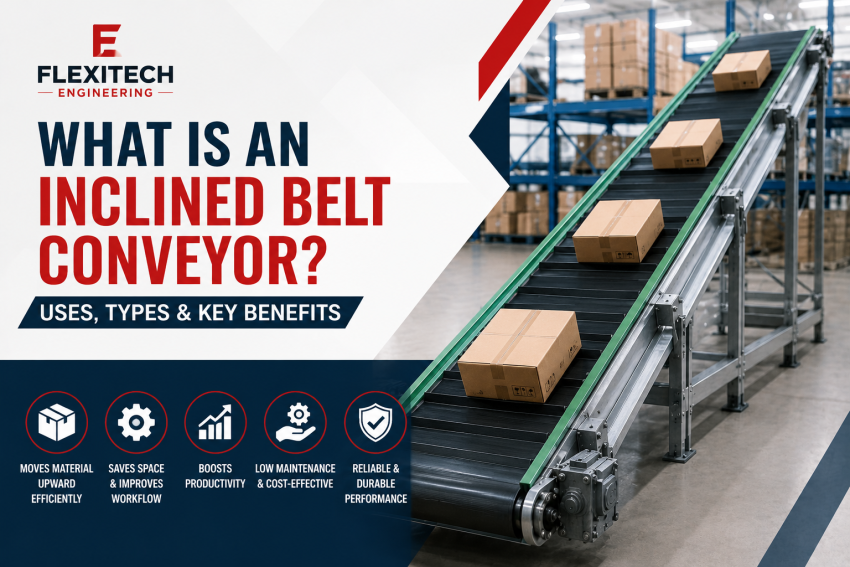
In modern industrial operations, moving materials between different elevation levels efficiently is a core challenge. Whether it’s lifting packaged goods to an upper floor, transferring components between workstations at varying heights, or loading products onto trucks, facilities need a reliable and space-saving solution. This is exactly where an inclined belt conveyor becomes essential.
An inclined belt conveyor is a material handling system designed to transport goods at an angle — upward or downward — rather than on a flat, horizontal plane. It combines the simplicity of a standard belt conveyor with the ability to handle elevation changes, making it one of the most versatile pieces of equipment in manufacturing, warehousing, and logistics.
In this guide, we’ll cover how inclined belt conveyors work, the different types available, where they are used, and the key benefits they bring to industrial operations.
How Does an Inclined Belt Conveyor Work?
The working principle of an inclined belt conveyor is straightforward. A continuous loop of belting material is stretched between two pulleys — a drive pulley at the upper end and a tail pulley at the lower end. An electric motor drives the drive pulley, which in turn moves the belt in a continuous loop.
Materials are placed on the lower end of the belt and carried upward (or downward) as the belt moves. The angle of inclination can range from as low as 5° to as high as 30°, depending on the type of material being conveyed and the design of the belt surface.
For steeper angles or materials that tend to slide, the belt may feature cleats, corrugated sidewalls, or a textured rubber surface to grip the product and prevent slippage during transport.
The structure is supported by a steel frame with idler rollers placed at intervals beneath the belt to maintain tension and prevent sagging. This roller-supported design ensures smooth, consistent movement even under continuous load.
Types of Inclined Belt Conveyors
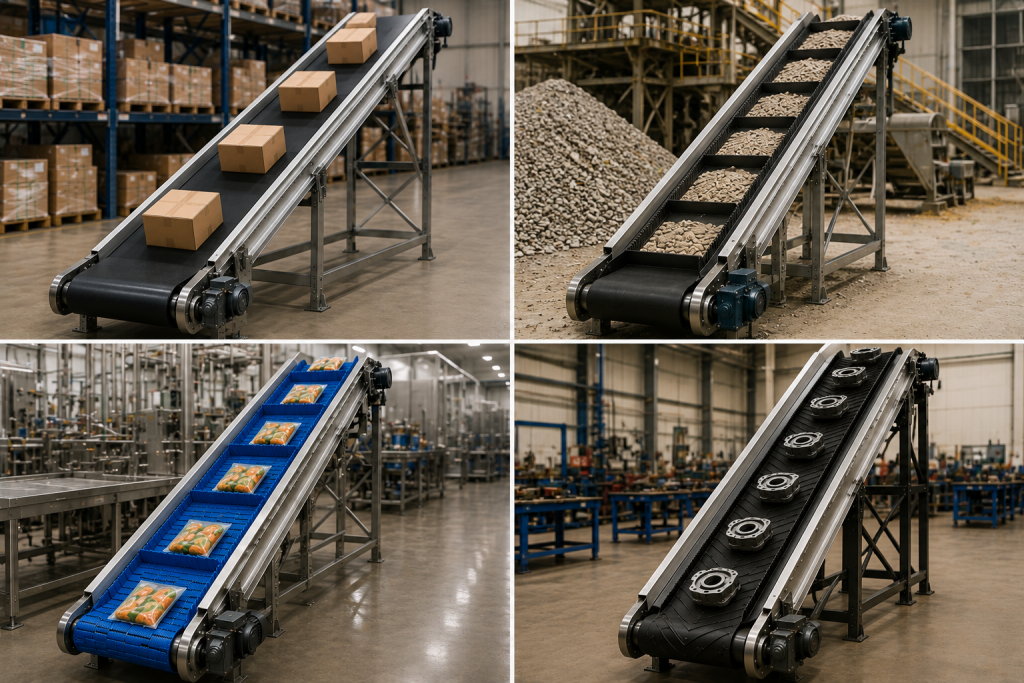
Different applications call for different inclined conveyor configurations. Here are the most common types:
1. Flat Belt Inclined Conveyor
The most common variant, using a smooth or lightly textured flat belt conveyor surface. Suitable for packaged goods, cartons, and stable products at moderate incline angles (typically up to 20°). It is widely used in warehouses, dispatch areas, and production lines where goods are boxed or wrapped.
2. Cleated Belt Inclined Conveyor
This type features raised cleats or fins attached across the belt width. The cleats prevent products from sliding back when the incline angle is steeper. It is commonly used for bulk materials, loose components, or agricultural products where a smooth belt would fail to hold the load.
3. Modular Belt Inclined Conveyor
Built with interlocking plastic modules instead of a continuous belt, the modular belt conveyor offers better drainage, easy cleaning, and greater flexibility in design. It is particularly useful in food processing, pharmaceutical, and hygiene-sensitive environments.
4. Rubber Belt Inclined Conveyor
A heavy-duty option with a rubber belt conveyor surface that provides excellent grip and durability. Best suited for heavy raw materials, castings, or industrial parts that require a strong, abrasion-resistant belt surface.
Where Are Inclined Belt Conveyors Used?
Inclined belt conveyors are found across a wide range of industries, wherever elevation changes are part of the workflow:
Warehousing & Logistics: Moving boxes, cartons, and parcels from ground level to elevated storage racks or loading docks.
Automotive Assembly: Transferring components between assembly stages that are set at different heights. These are often used alongside assembly conveyors and three wheeler assembly conveyors in vehicle manufacturing plants.
Food & Beverage Processing: Elevating food products between processing and packaging stations while maintaining hygiene standards.
Battery & Electronics Manufacturing: Used in battery assembly lines and LED TV assembly lines to move delicate components carefully between levels without manual handling.
Mining & Construction: Transporting extracted materials like sand, gravel, or ore from lower excavation levels to elevated stockpiles or processing units.
Truck Loading & Dispatch: Helping operators load goods directly into truck containers without heavy lifting, replacing the need for a truck loading conveyor operated entirely by manual labour.
Key Benefits of Inclined Belt Conveyors
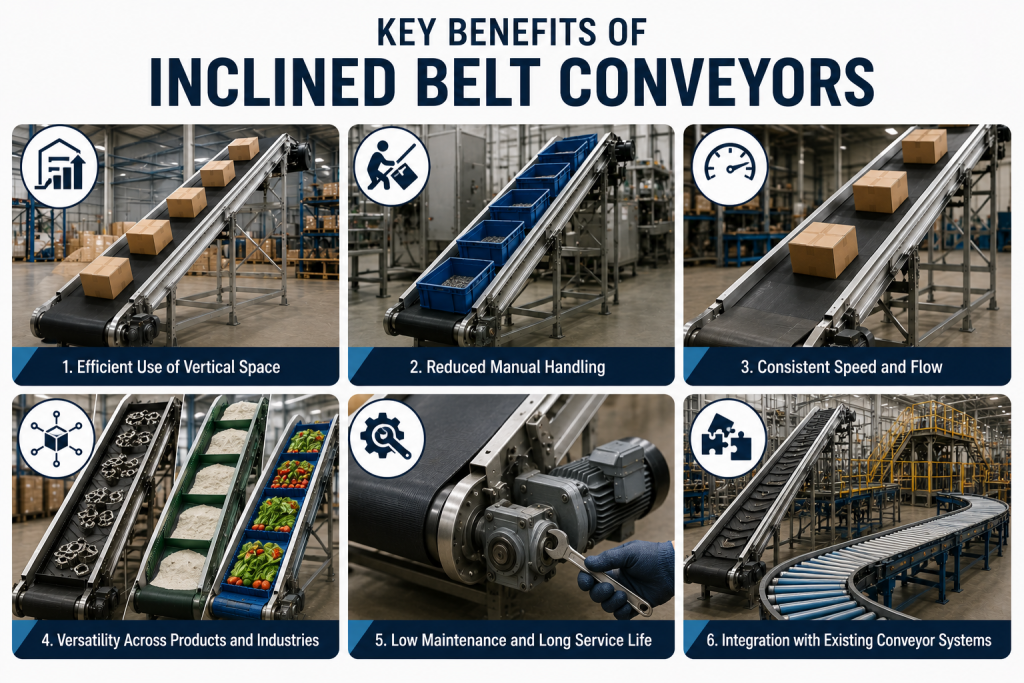
1. Efficient Use of Vertical Space
One of the biggest advantages of an inclined belt conveyor is its ability to utilise vertical space within a facility. Instead of building ramps, installing lifts, or relying on manual labour to shift materials between floors or levels, an inclined conveyor integrates seamlessly into the building layout and automates elevation transfer in a compact footprint.
2. Reduced Manual Handling
Manual lifting of heavy goods between levels is a significant source of workplace injuries and operational delays. Inclined conveyors eliminate this risk by automating the elevation process entirely. This is especially critical in automotive plants, electronics facilities, and warehouses where repetitive lifting can slow production and increase injury rates.
3. Consistent Speed and Flow
Unlike manual material handling, an inclined belt conveyor delivers materials at a consistent, adjustable speed. This regularity is crucial for production lines where upstream and downstream processes must remain synchronised. Variable speed drives allow operators to match conveyor speed with production demands in real time.
4. Versatility Across Products and Industries
Inclined belt conveyors can be customised to handle an extraordinarily wide range of products — from small electronic components to heavy automotive parts, from loose agricultural produce to sealed consumer goods. The belt material, cleat design, width, and inclination angle can all be adjusted to suit the specific product and environment.
5. Low Maintenance and Long Service Life
With fewer moving parts compared to mechanical lifts or chain-based systems, inclined belt conveyors are relatively simple to maintain. Regular inspection of the belt tension, idler rollers, and drive motor is typically sufficient to keep the system running for years. Quality units built with durable frame structures and robust roller assemblies will deliver long-term reliability with minimal downtime.
6. Integration with Existing Conveyor Systems
An inclined belt conveyor does not need to operate in isolation. It can be directly integrated with horizontal conveyors, gravity roller conveyors, powered roller conveyors, and overhead conveyors to create a complete, end-to-end material handling solution. This interconnectedness makes it an ideal component in fully automated production and warehousing environments.
Choosing the Right Inclined Belt Conveyor for Your Facility
Selecting the correct inclined belt conveyor depends on several key factors:
Type of product: Is it packaged, loose, fragile, or heavy? This determines the belt material and surface design.
Angle of incline: Steeper angles (above 20°) typically require cleated belts to prevent backslide.
Load capacity: The frame structure, motor power, and belt thickness must match the weight requirements.
Environment: Dusty, wet, or chemically active environments require specific belt materials and frame coatings.
Integration requirement: Does the conveyor need to connect with other conveyor types or automated systems?
Consulting with an experienced conveyor manufacturer ensures the system is engineered to meet your exact operational requirements rather than applying a one-size-fits-all solution.
Why Choose Flexitech Engineering for Inclined Belt Conveyors?
Flexitech Engineering is a trusted manufacturer and supplier of industrial conveyor systems across India. With deep expertise in designing customised material handling solutions, Flexitech offers inclined belt conveyors built to precise client specifications — covering load requirements, inclination angles, belt materials, and integration needs.
From manufacturing facilities to warehousing and logistics operations, Flexitech’s conveyor systems are engineered for reliability, durability, and long-term performance. Whether you need a standalone inclined conveyor or a fully integrated conveyor network combining flat belt, roller, modular, and overhead systems, Flexitech has the capability to deliver end-to-end solutions.
Get in touch with the Flexitech team today to discuss your material handling requirements and find the right inclined belt conveyor for your facility.