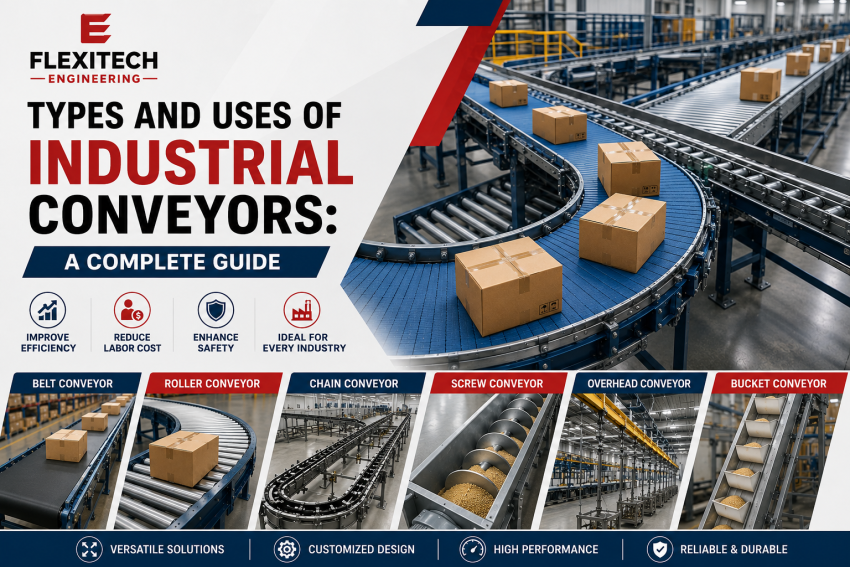
Industrial conveyor systems are the foundation of modern manufacturing, warehousing, and material handling operations. From small assembly workshops to large-scale automated distribution centres, conveyors reduce manual labour, improve throughput, and ensure consistent, safe movement of materials across the production floor.
With so many types of industrial conveyors available — each designed for specific load types, environments, and throughput requirements — understanding which system suits your needs is essential before making an investment. This guide covers all major types of conveyor systems, their working principles, key features, and the industries where they are most commonly used.
1. Assembly Line Conveyors
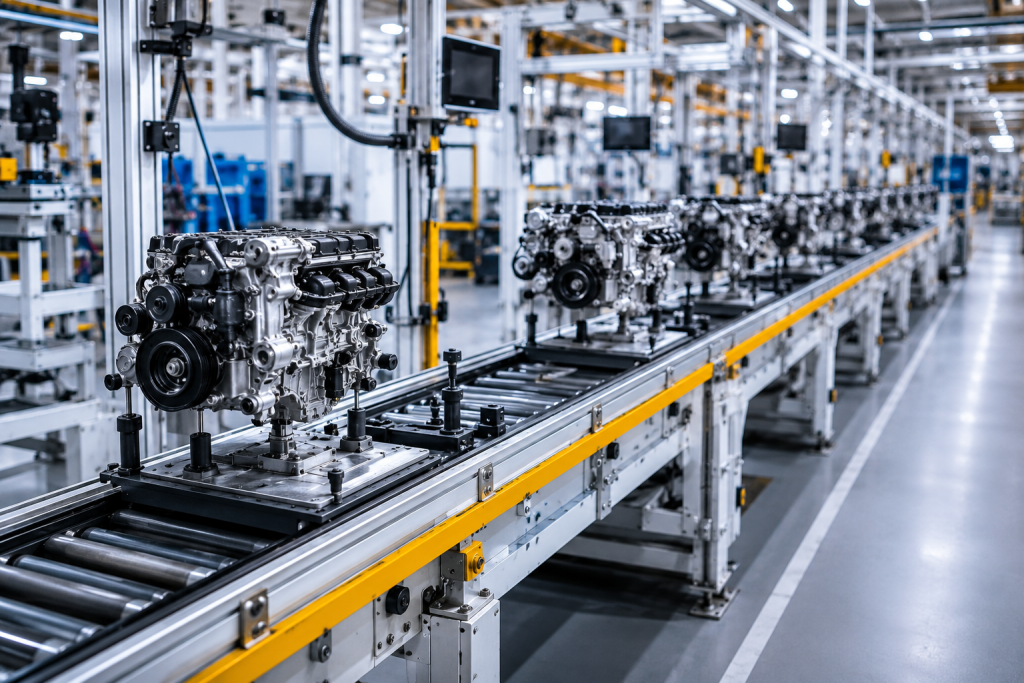
Assembly line conveyors are purpose-built for sequential manufacturing processes where a product moves from one workstation to the next in a controlled, timed manner. Each operator or machine performs a specific task at their station, and the conveyor advances the product automatically or on command.
Assembly conveyors are designed to synchronise production flow, eliminate bottlenecks, and maintain consistent cycle times across all workstations. They can be configured as flat belt, roller, or slat-chain systems depending on the product type and weight.
Common Industries and Applications
- Automobile and two-wheeler assembly plants
- Three-wheeler and electric vehicle (EV) production lines
- LED television and consumer electronics manufacturing
- Battery pack assembly for lithium-ion and industrial batteries
- Assembly line for refrigerator, air conditioner, and white goods manufacturing
- ESD workstation conveyors for static-sensitive electronic components
Key features to look for in an assembly conveyor include variable speed control, ergonomic working height, anti-static surface options, and compatibility with overhead hoists, jigs, and fixtures.
2. Roller Conveyors
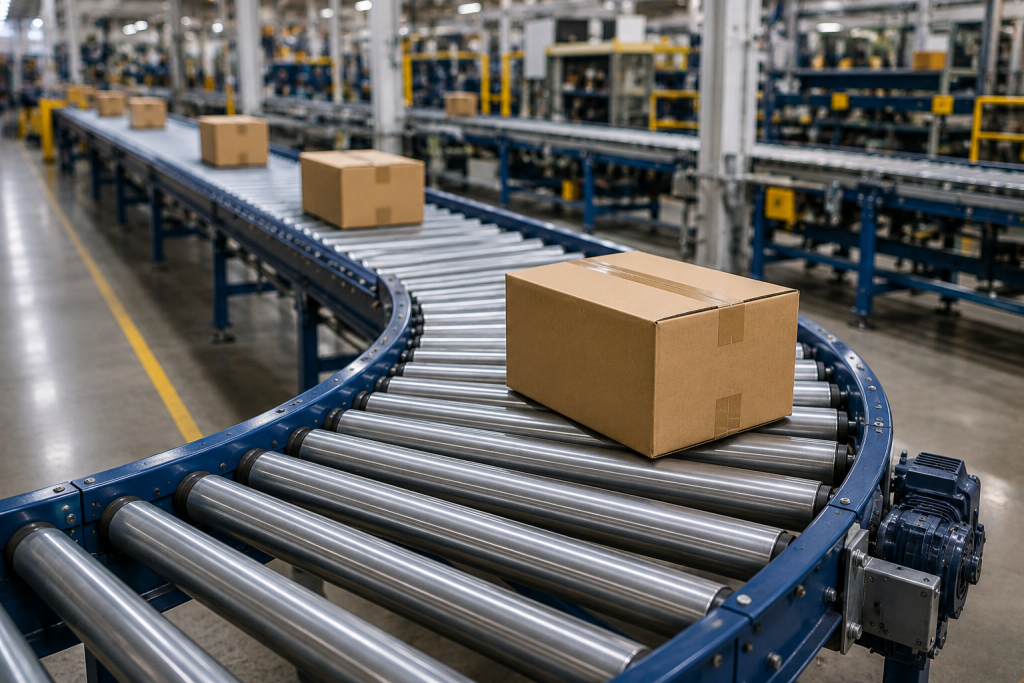
Roller conveyors are among the most versatile and widely deployed conveyor types in industrial facilities. They consist of cylindrical rollers mounted at regular intervals on a steel or aluminium frame. Products travel across the rollers either by gravity, manual push, or motorised drive.
Roller conveyors are ideal for handling boxed goods, cartons, crates, pallets, and any product with a rigid, flat base. Their open-frame design also allows easy access from the sides and below — making them practical for assembly, inspection, and packing operations.
Gravity Roller Conveyors
Gravity roller conveyors use no electricity. Products move along an inclined or flat surface under the force of gravity or a manual push. They are a cost-effective solution for loading docks, shipping and receiving areas, and short conveyor runs where automation is not required. Zero energy consumption and minimal maintenance make gravity roller conveyors a popular choice for budget-conscious operations.
Powered Roller Conveyors
Powered roller conveyors, also called live roller conveyors, use motorised drives — belt-driven, chain-driven, or individual 24V DC motorised rollers (MDR) — to move products automatically along the conveyor. They maintain consistent speed, support accumulation and zone control, and integrate with warehouse automation systems. MDR-based powered roller conveyors are particularly energy-efficient, activating only when a product is present in a zone.
Flexible Roller Conveyors
Flexible conveyors can be expanded, curved, and repositioned to suit changing layouts. They are widely used in retail back-of-store operations, temporary warehousing setups, and truck loading and unloading areas where fixed installations are not practical.
Bend Roller Conveyors
Bend roller conveyors allow product flow to change direction — typically at 30°, 45°, or 90° angles — without manual transfer between conveyor sections. They are essential in facilities where space constraints prevent straight-line conveyor routing.
3. Belt Conveyors
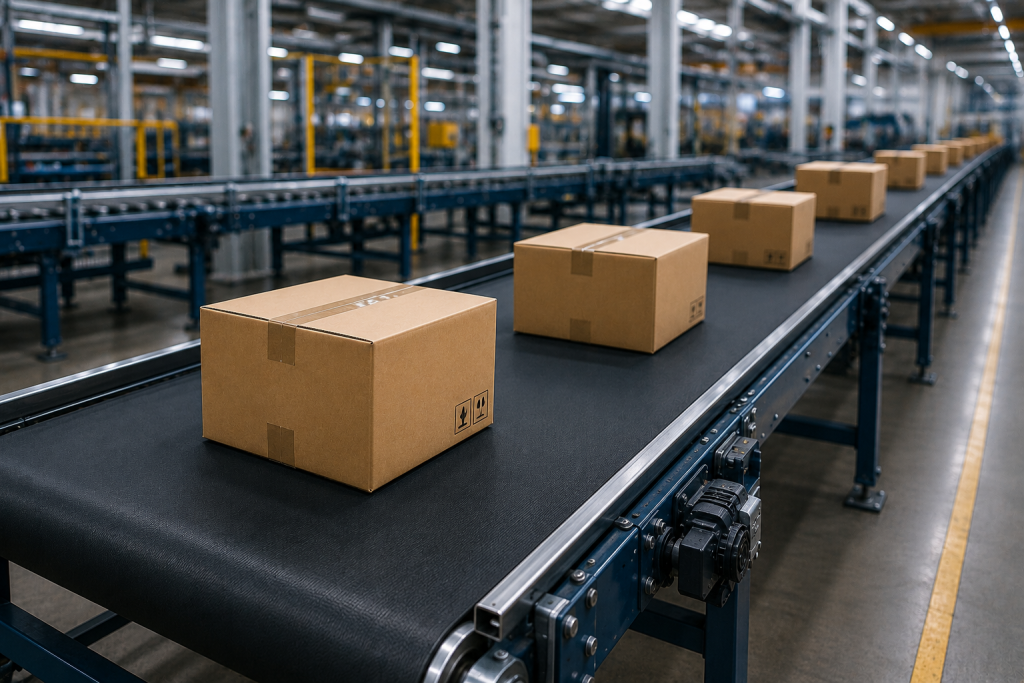
Belt conveyors use a continuous looped belt — made from rubber, PVC, polyurethane, or fabric — driven by a motorised pulley at one end. They provide a smooth, uniform surface suitable for carrying products that cannot sit stably on rollers, including loose items, irregularly shaped products, and bulk materials.
Belt conveyors are one of the most common conveyor types globally, found in industries ranging from food processing and packaging to mining, agriculture, and airport baggage handling.
Flat Belt Conveyors
Flat belt conveyors are used for lightweight to medium-weight products on horizontal or slightly inclined runs. They are standard equipment in packaging lines, inspection stations, and food production environments. Food-grade belt materials, stainless steel frames, and wash-down designs are available for hygienic applications.
Inclined Belt Conveyors
Inclined belt conveyors move products between different height levels — from floor to mezzanine, between process stages, or from production to storage. Belt cleats, side walls, and rough-top belt surfaces prevent products from sliding back on steep inclines. Inclined belt conveyors are widely used in warehousing, mining, agriculture, and manufacturing where vertical product transfer is required.
4. Modular Belt Conveyors
Modular belt conveyors use interlocking plastic or metal segments rather than a continuous belt. Individual segments can be replaced without changing the entire belt surface — significantly reducing maintenance downtime. The modular design also enables curved, inclined, and spiral configurations that traditional flat belts cannot achieve.
Modular belt conveyors are particularly popular in the food processing, pharmaceutical, automotive, and beverage industries where hygiene, easy cleaning, and complex routing are priorities. Individual belt modules can be removed, cleaned, and replaced without specialist tools.
- Available in food-grade, anti-static, and high-temperature resistant materials
- Supports curved layouts and tight turning radii
- Suitable for products with irregular bottom surfaces or delicate packaging
- Stainless steel frame construction available for clean-room and washdown environments
5. Overhead Conveyors
Overhead conveyors suspend products from an elevated chain or rail system, freeing the entire floor area beneath for workers, equipment, and other operations. They are a smart solution for facilities where floor space is limited or where products need to pass through multiple process stages — such as painting, powder coating, drying, and cooling — on a single continuous line.
- Maximises floor space utilisation in high-density production facilities
- Enables multiple processes along a single conveyor path
- Reduces product contamination from ground-level debris and activity
- Ideal for heavy components — automotive body panels, engine parts, large fabrications
- Available in enclosed track (inverted power and free) and open chain configurations
Overhead conveyors are standard in automotive body shops, paint lines, garment factories, and cold storage facilities.
6. Rubber Belt Conveyors
Rubber belt conveyors are the standard solution for heavy-duty bulk material handling in industries such as mining, quarrying, cement, steel, power generation, and port operations. The thick, reinforced rubber belt is designed to handle abrasive, heavy, and sometimes high-temperature materials over long distances and at high throughput rates.
- Handles bulk materials: sand, gravel, coal, iron ore, limestone, and more
- Available in belt widths from 300mm to 1800mm and beyond
- Suitable for long-distance horizontal and steeply inclined conveyance
- Can incorporate belt scrapers, skirting boards, and dust suppression systems
- Heat-resistant, oil-resistant, and fire-resistant belt grades available
In manufacturing environments, rubber belt conveyors are used to move metal scrap, castings, forgings, and other heavy or abrasive components away from machining and fabrication areas.
7. Slat Conveyors
Slat conveyors use a series of rigid, flat metal plates — called slats — mounted on a continuous chain drive. Unlike belt conveyors, slat surfaces can withstand heat, sharp edges, heavy impact, and abrasive contact that would quickly damage a rubber or PVC belt.
Slat conveyors are widely used in automotive manufacturing (engine assembly, body-in-white lines), heat treatment plants, forging and casting facilities, and anywhere that heavy, hot, or sharp components need to be conveyed reliably. They are also used in assembly lines where workers need to stand on the conveyor deck alongside the product.
8. Spiral Conveyors and Vertical Goods Lifts
Spiral Conveyors
Spiral conveyors move products continuously between floor levels in a helical path around a central column. They are ideal for facilities where vertical product transfer is required but floor space is too limited for an inclined belt or a large footprint vertical lift. Spiral conveyors are commonly used in food and beverage production, e-commerce fulfilment, and pharmaceutical manufacturing for moving products between floors in a controlled, continuous flow.
Vertical Conveyors and Goods Lifts
Vertical conveyors and goods lifts transfer products or pallets directly upward or downward between levels in a straight vertical path. Unlike spiral conveyors, they are suited to intermittent, high-load transfers rather than continuous flow. They are common in warehouses with multi-level mezzanines, manufacturing plants with separated floor levels, and facilities handling heavy unit loads that cannot be inclined.
9. Telescopic Conveyors and Truck Loading Conveyors
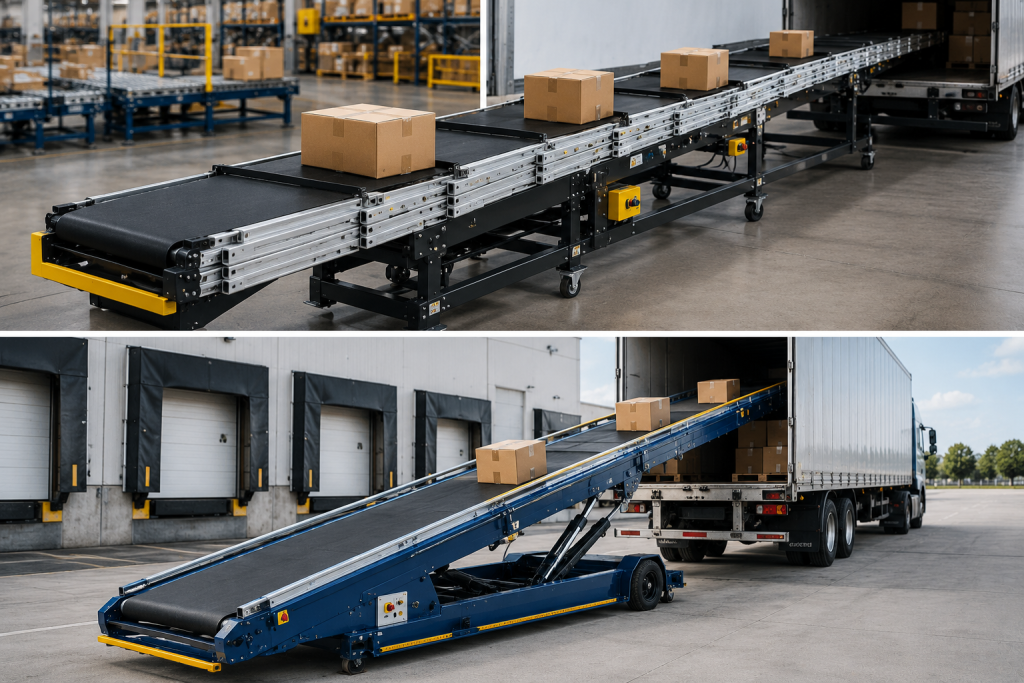
Telescopic conveyors extend and retract to bridge the gap between a warehouse loading dock and the interior of a truck or container. They dramatically reduce the time and manual labour required to load and unload vehicles, and are a standard feature in high-volume dispatch and distribution centres.
Truck loading conveyors provide a fixed or adjustable-height bridge between the dock and the vehicle, while telescopic conveyors can extend deep into the truck interior — enabling a single operator to load or unload a full container without walking in and out repeatedly.
- Reduces loading and unloading time by up to 70% compared to manual methods
- Minimises worker fatigue and risk of musculoskeletal injuries
- Available in belt, roller, and skate wheel surface configurations
- Suitable for cartons, bags, tyres, and other unit loads
10. Pneumatic Conveying Systems
Pneumatic conveying systems transport bulk powders, granules, and fine particulate materials through enclosed pipelines using either pressurised air or vacuum. Unlike mechanical conveyors, pneumatic systems are fully enclosed — eliminating dust emissions, product contamination, and spillage.
They are the standard solution in food ingredient handling (flour, sugar, starch), cement and fly ash transfer, plastic pellet conveying, pharmaceutical powder handling, and chemical processing — wherever hygiene, containment, and dust control are critical requirements.
- Dilute phase conveying: high velocity, low pressure — suitable for light, non-abrasive materials
- Dense phase conveying: low velocity, high pressure — for fragile, abrasive, or heavy materials
- Vacuum conveying: pulls material from multiple pickup points into a central receiver
- Fully enclosed — no dust, no spillage, no contamination risk
- Can convey over long distances and complex routing with bends and elevation changes
11. Free Flow Conveyors and FIFO Rack Systems
Free Flow Conveyors
Free flow conveyors allow individual products or pallets to move independently along a common track, accumulating at workstations without stopping the entire line. This decoupling of production stages is essential in assembly lines where different stations have varying cycle times. Free flow systems prevent bottlenecks and allow operators to work at their own pace within defined limits.
FIFO Racks and Joints
FIFO (First In, First Out) rack and lane systems use inclined roller or wheel tracks to ensure that the oldest stock is always picked first — the item that went in first comes out first. This is critical in food manufacturing, pharmaceutical storage, and any perishable goods environment where stock rotation directly impacts product quality, shelf life, and regulatory compliance.
12. Special Purpose Machines (SPM) in Conveyor Systems
Special Purpose Machines — commonly referred to as SPMs — are custom-engineered machines built to perform a specific manufacturing or material handling task that standard off-the-shelf equipment cannot fulfil. In the context of conveyor systems, SPMs are often integrated directly into the conveyor line to perform tasks such as automatic feeding, part orientation, press fitting, testing, marking, or rejection.
SPMs are widely used in automotive component manufacturing, electrical assembly, consumer goods production, and precision engineering — wherever a standard machine cannot meet the specific process requirement of the production line.
About Flexitech Engineering
Flexitech Engineering is an experienced manufacturer and supplier of industrial conveyor systems based in India. We design and build a wide range of conveyors — including assembly line conveyors, gravity and powered roller conveyors, belt conveyors, slat conveyors, overhead systems, and more — for clients across the automotive, electronics, manufacturing, and logistics sectors.
All systems are manufactured in-house to ensure quality control, faster delivery, and the flexibility to customise every conveyor to the client’s exact specifications. Whether you need a single conveyor section or a complete turnkey production line, Flexitech Engineering provides end-to-end support from design and manufacturing through to installation and commissioning.
Conclusion
Industrial conveyor systems are not a single product — they are a diverse family of solutions, each engineered for specific tasks, environments, and industries. Understanding the differences between assembly conveyors, roller conveyors, belt conveyors, overhead systems, pneumatic conveyors, and the many other types available is the first step toward making the right investment for your facility.
The right conveyor system reduces labour costs, improves throughput, prevents product damage, and creates a safer working environment. With the correct system in place, businesses can scale production confidently — knowing their material handling infrastructure will keep pace with growth.