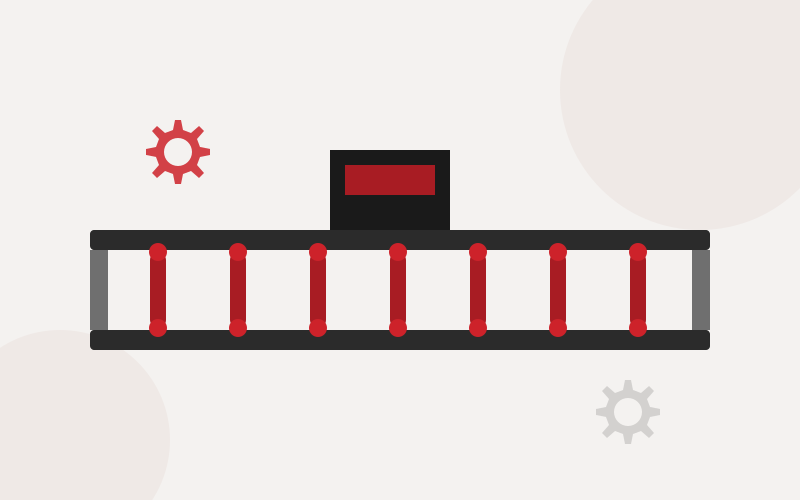
An accumulation roller chain conveyor lets product build up and wait on the line — at a workstation, before a machine, or ahead of a bottleneck — without the pieces behind it jamming, tipping, or being crushed against each other. It's one of the most common conveyor types on assembly and packaging lines where different stations don't all run at exactly the same speed.
Working principle
The conveyor uses rollers driven by a chain running beneath them, rather than a single continuous belt. Because each roller (or small group of rollers) can slip against the drive chain once resistance builds up — for example, when a product ahead has stopped — the line keeps turning at a controlled low torque instead of forcing every product forward at full line speed. Product already queued simply free-wheels in place until the item ahead moves on.
Key components
- Drive chain — runs the length of the conveyor beneath the rollers, providing the motive force.
- Accumulation rollers — fitted with a chain-and-sprocket or friction clutch arrangement so they can slip under load without stalling the drive.
- Guide rails and side guards — keep product aligned on the rollers as it queues.
- Sensors / stop mechanisms — photo-eyes or mechanical stops at zone boundaries, used on zero-pressure accumulation lines to release product only when the zone ahead is clear.
Zero-pressure vs. minimum-pressure accumulation
On a minimum-pressure line, queued product rests gently against the item ahead of it — fine for robust cartons and packages. On a zero-pressure accumulation line, sensors and zone controls stop each item just behind the one ahead so that no product-to-product contact force builds up at all — important for fragile, unstable, or easily marked loads.
Typical applications
Accumulation roller chain conveyors are widely used ahead of packing stations, palletisers, wrapping machines, and inspection points — anywhere upstream and downstream equipment can run at slightly different speeds and a buffer is needed to keep the whole line moving without manual intervention.