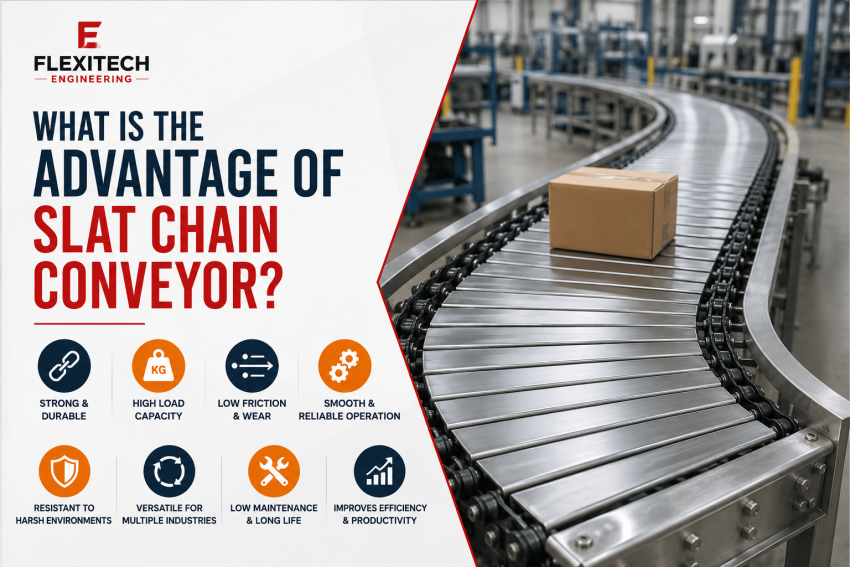
In industrial material handling, choosing the right conveyor system is one of the most consequential decisions a plant engineer or operations manager can make. The conveyor type directly impacts production speed, product quality, maintenance frequency, and long-term operating costs. Among the many options available today — belt conveyors, roller conveyors, overhead systems, and more — the slat chain conveyor stands out as a particularly versatile and robust solution for demanding environments.
A slat chain conveyor, also known as a slat conveyor or plate chain conveyor, uses a series of rigid, flat slats — typically made from steel, stainless steel, or aluminium — mounted on a continuous chain drive. Unlike flexible belt conveyors that depend on a single looped belt, slat chain conveyors rely on the structural integrity of individual plates, making them exceptionally suited for heavy, hot, sharp, or irregularly shaped loads that would damage or deform conventional belt systems.
So what exactly makes slat chain conveyors advantageous across so many industries? Let us explore in detail.
1. Exceptional Load-Bearing Capacity
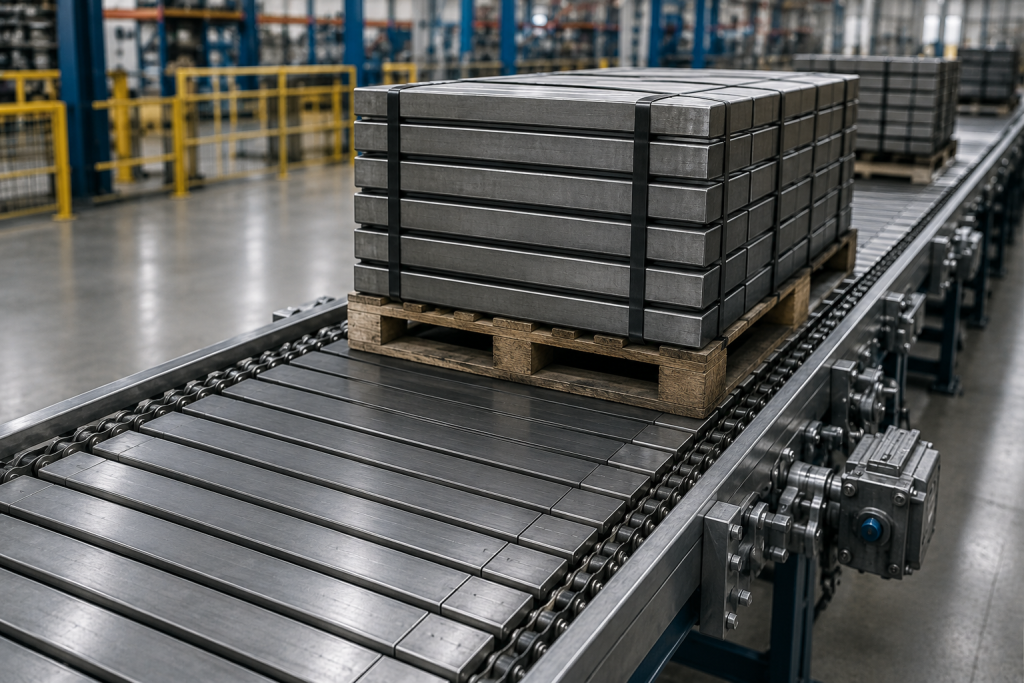
One of the most significant advantages of a slat chain conveyor is its ability to carry extremely heavy loads. The rigid metal slats, combined with a heavy-duty chain drive, distribute weight evenly across the conveyor surface. This allows the system to transport large castings, automotive body panels, engine blocks, metal stampings, and other high-weight components that would overstress a standard belt conveyor.
In automotive manufacturing — particularly in press shops and assembly lines that handle vehicle chassis and frames — Slat Conveyor systems are the preferred choice precisely because they can sustain continuous heavy loads without sagging, stretching, or wearing out prematurely. Similarly, in heavy engineering and foundry operations, slat chain conveyors move metal billets and castings that may weigh several hundred kilograms per unit.
This high load capacity translates directly into production reliability — fewer breakdowns, less downtime, and lower replacement costs over the equipment’s operational life.
2. Outstanding Heat and Temperature Resistance
Standard rubber or PVC belt conveyors are highly susceptible to heat damage. Prolonged exposure to elevated temperatures causes belts to crack, stretch, or melt — leading to costly replacements and unexpected shutdowns. Slat chain conveyors are built from metal, which makes them inherently resistant to high temperatures.
This makes them an ideal solution in industries such as:
Foundries and steel plants, where hot castings or ingots need to be transported away from furnaces. Food processing units where products pass through baking ovens or heat-sealing stations. Automotive paint shops, where vehicle bodies move through high-temperature curing ovens on overhead or floor-mounted slat chain systems. Glass manufacturing, where hot glass products must be moved on heat-resistant surfaces immediately after forming.
Because the metal slats can withstand sustained heat exposure without deformation, slat chain conveyors deliver long-term performance in environments that would quickly destroy conventional conveyor belts.
3. Superior Durability and Long Service Life
Durability is a defining characteristic of slat chain conveyors. The individual metal slats are far more resistant to physical damage than rubber belts — they do not tear, puncture, or fray when handling sharp-edged or abrasive materials. This is critical in industries like metal fabrication, automotive stamping, and mining, where loads frequently have rough, sharp, or uneven surfaces.
While a Rubber Belt Conveyor or a Flat Belt Conveyor may need belt replacement within a few years under heavy-duty conditions, a well-maintained slat chain conveyor can run for decades with only periodic lubrication and chain tension adjustments. The individual slats can also be replaced independently if one is damaged — making maintenance far more cost-effective compared to replacing an entire belt.
This longevity represents a significant return on investment, particularly for high-volume production environments where conveyor downtime has a direct impact on output targets.
4. Smooth and Stable Product Transport
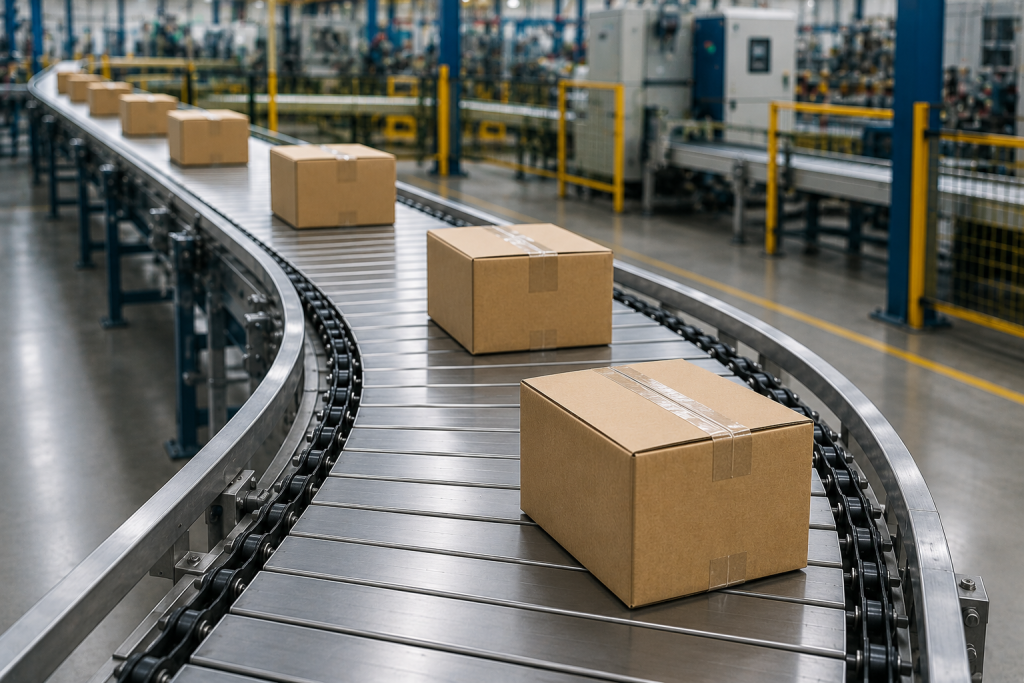
Unlike roller conveyors where products rest on individual rollers with small gaps between them, slat chain conveyors provide a completely flat, continuous surface for product transport. This is highly advantageous when handling items that are:
Small in size and could fall between roller gaps. Fragile and prone to tipping or shifting. Irregularly shaped and need a stable resting surface throughout their journey.
In consumer goods manufacturing and electronics assembly — for instance, on an Assembly Line for Refrigerator & Air Conditioning — slat conveyors provide the stable, flat transport surface needed to prevent components from shifting or toppling during movement. The controlled, uniform surface also ensures that products arrive at each workstation in the exact orientation required for the next assembly step.
5. Ease of Cleaning and Hygiene Compliance
In food and beverage processing, pharmaceutical manufacturing, and personal care product industries, hygiene is not optional — it is a regulatory requirement. Slat chain conveyors are easy to clean because their metal surface does not harbour bacteria the way porous materials can, and they can withstand high-pressure water washdowns, steam cleaning, and chemical sanitisation.
Stainless steel slat conveyors are specifically built for food-grade applications where sanitation standards must be met consistently. They can be cleaned between product runs without damage, and their open or drainage-friendly designs ensure liquids do not pool on the conveyor surface — further reducing contamination risk.
This hygienic advantage makes slat chain conveyors a trusted choice in meat processing, dairy operations, bakery lines, and pharmaceutical packaging units.
6. Customisable Configurations for Complex Layouts
No two factories have the same layout, and slat chain conveyors are engineered with this in mind. They can be configured in straight sections, curves, inclines, declines, and even complex multi-level arrangements, making them adaptable to virtually any plant floor design.
Where products need to move vertically between different production levels, slat chain conveyors can be combined with a Vertical Conveyor & Goods Lift for integrated floor-to-floor material flow. Where overhead space is being utilised, slat chain systems can be adapted into Overhead Conveyor configurations, freeing up the factory floor for other operations while maintaining continuous product movement above.
Slat width, chain pitch, speed, and drive configurations can all be customised to meet specific load requirements, production rates, and spatial constraints — making each slat chain conveyor system a precision-engineered solution rather than a generic product.
7. Compatibility with Automated Assembly Processes
Modern manufacturing is increasingly automated, and conveyor systems must support seamless integration with robots, automated inspection systems, barcode scanners, and programmable logic controllers (PLCs). Slat chain conveyors are well-suited to automated environments because of their rigid, predictable surface and consistent, controllable speed.
In automotive two-wheeler and three-wheeler assembly plants, Two Wheeler Assembly Conveyor lines built on slat chain platforms allow robotic arms and automated torque tools to work on moving vehicles with exact repeatability. The rigid surface ensures the vehicle is always at the correct height and position for each automated operation — eliminating errors caused by surface flex or inconsistent product positioning.
This compatibility with automation also extends to battery manufacturing, where Battery Assembly Line conveyors must coordinate precisely with robotic cell assembly and automated testing stations.
8. Low Noise and Vibration in Operation
One often-overlooked advantage of slat chain conveyors is their relatively smooth and quiet operation compared to some other heavy-duty conveyor types. When properly lubricated and maintained, the chain and slat mechanism runs with minimal vibration — which is important when transporting precision components or assembled products where excessive vibration could dislodge parts or affect alignment.
In electronics assembly environments, reduced vibration during transport prevents micro-damage to circuit boards, displays, and delicate sub-assemblies — protecting product quality throughout the line.
9. Versatility Across Industries
Perhaps the broadest advantage of slat chain conveyors is how universally applicable they are. Very few other conveyor types serve such a wide range of industries with equal effectiveness. From automotive stamping lines to food packaging, from foundry operations to pharmaceutical production, the slat chain conveyor adapts to the demands of each environment while maintaining its core strengths of durability, load capacity, and reliability.
In logistics and warehousing, slat conveyors handle heavy cartons and industrial components that would damage lighter systems. In FMCG production, they keep high-speed packing lines running without interruption. Alongside systems like Powered Roller Conveyor and Modular Belt Conveyor lines, slat chain conveyors complete the material handling ecosystem of a modern industrial facility.
10. Reduced Long-Term Operating Costs
When evaluating any industrial conveyor, total cost of ownership matters as much as the initial purchase price. Slat chain conveyors, despite having a higher upfront cost than basic belt systems, consistently deliver lower long-term operating costs due to:
Infrequent belt replacement (metal slats last significantly longer than rubber or PVC belts). Lower energy consumption in many configurations due to efficient chain drive mechanics. Minimal product damage during transport, reducing rework and rejection rates. Simple, modular maintenance — individual slats can be replaced without dismantling the entire system. Longer intervals between major overhauls compared to belt-based systems.
For high-throughput, round-the-clock production facilities, these savings accumulate significantly over the equipment’s lifetime — making the slat chain conveyor a financially sound long-term investment.
About Flexitech Engineering
Flexitech Engineering is a trusted manufacturer of industrial conveyor systems across India, offering high-quality slat conveyors, assembly line conveyors, roller conveyors, belt conveyors, overhead systems, and more. With expertise spanning multiple industries — from automotive and electronics to food processing and heavy engineering — Flexitech Engineering provides end-to-end conveyor solutions tailored to your specific production needs.
Looking to upgrade your material handling setup with a durable, high-performance slat chain conveyor? Get in touch with the Flexitech Engineering team today.
Conclusion
The slat chain conveyor is not simply an alternative to belt or roller conveyors — it is a purpose-built solution for the most demanding material handling challenges in modern industry. Its ability to carry heavy loads, resist heat and physical damage, support hygienic operation, integrate with automation, and deliver decades of reliable service makes it one of the most valuable conveyor systems available today.
Whether you are running an automotive assembly plant, a food processing facility, a foundry, or a logistics warehouse, understanding the advantages of slat chain conveyors is the first step toward building a more efficient, resilient, and productive operation.