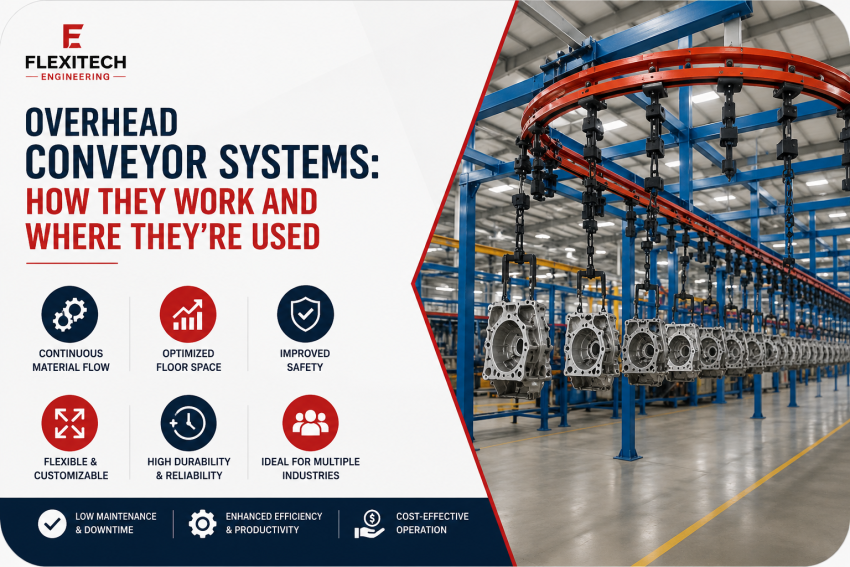
Floor space is one of the most valuable and limited resources in any manufacturing or industrial facility. As production volumes grow and operations expand, the pressure to optimise available space intensifies. This is where overhead conveyor systems offer a significant strategic advantage — by moving material handling off the floor and into the unused airspace above.
An overhead conveyor is a material handling system suspended from the ceiling or an elevated structure, designed to transport products, components, or assemblies through a facility without occupying any floor area. This makes them particularly valuable in facilities where floor space is consumed by machinery, workstations, and personnel movement.
In this guide, we explain how overhead conveyor systems work, the different types available, the industries where they are most widely used, and the key benefits they deliver to modern manufacturing and production environments.
How Does an Overhead Conveyor System Work?
An overhead conveyor system operates by suspending a track or rail from the ceiling structure of a facility. Products or carriers are attached to trolleys or hooks that run along this elevated track, driven by a motor-powered chain, belt, or monorail mechanism.
The basic components of an overhead conveyor include:
Overhead track or rail: A structural channel suspended from ceiling-mounted brackets, forming the pathway along which carriers travel.
Trolleys or carriers: Wheeled units that run inside the track and hold hooks, hangers, or custom fixtures to carry the product.
Drive system: A motor-driven chain or belt that propels the trolleys along the track at a controlled, consistent speed.
Take-up unit: Maintains proper tension in the drive chain to ensure smooth, uninterrupted movement.
Control panel: Manages speed, direction, start/stop operations, and integration with downstream processes.
The track layout can be designed as a continuous loop or as a point-to-point route, with curves, inclines, declines, and switches incorporated as needed to navigate around the facility’s layout. This flexibility allows overhead conveyors to travel through painting booths, drying ovens, assembly zones, and storage areas — all within a single, unbroken system.
Types of Overhead Conveyor Systems
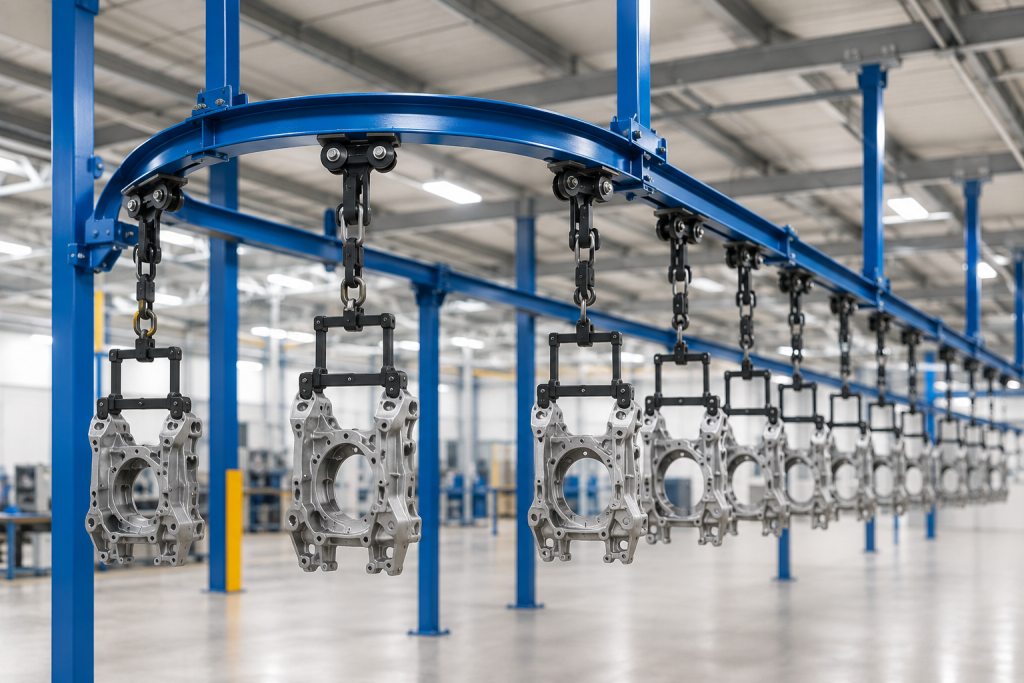
Several configurations of overhead conveyors exist, each suited to different load types, production speeds, and operational requirements.
1. Power and Free Overhead Conveyor
The most widely used type in heavy manufacturing, the power and free system uses two separate tracks — a powered upper track that continuously drives a chain, and a lower free flow conveyor track where carriers can stop, accumulate, or divert independently. This allows individual carriers to be held at a workstation while others continue moving, enabling flexible, non-synchronised production flow.
Power and free overhead conveyors are the system of choice for automotive assembly plants, appliance manufacturing, and any operation where workstation dwell times vary across the production line.
2. Enclosed Track Overhead Conveyor
In this system, the drive chain and trolleys run within a fully enclosed I-beam or C-channel track. The enclosed design protects the chain from dust, paint overspray, and contaminants, making it ideal for finishing operations such as powder coating, electroplating, and spray painting. The enclosed track also reduces noise levels and extends the service life of the drive chain significantly.
3. Monorail Overhead Conveyor
A simpler, lighter-duty variant where carriers travel along a single suspended rail. Monorail systems are suitable for lighter loads and straightforward point-to-point transport. They are commonly seen in garment factories, dry cleaning facilities, retail distribution centres, and food processing plants where loads are light and routing is relatively simple.
4. Electrified Monorail System (EMS)
An advanced overhead conveyor type where individual carriers are self-powered by an electrified rail. Each carrier moves independently, controlled by a central system, allowing highly flexible and precise routing. EMS systems are used in sophisticated assembly environments such as electronics manufacturing, semiconductor facilities, and high-precision automotive plants.
Where Are Overhead Conveyor Systems Used?
Overhead conveyors are deployed across a broad range of industries wherever floor space efficiency, continuous product flow, and process integration are priorities.
Automotive Manufacturing
Automotive plants are perhaps the most recognisable users of overhead conveyor systems. Vehicle bodies, chassis, and major subassemblies are transported through welding, painting, and final assembly stages on overhead carriers. The system enables workers to access all sides of the vehicle comfortably while it moves steadily through the production line. In two-wheeler and three wheeler assembly conveyor operations, overhead systems are similarly used to move frames and subassemblies through paint and assembly zones.
Paint, Powder Coating & Surface Finishing
One of the most critical applications of overhead conveyors is in surface finishing operations. Parts are hung on carriers and transported continuously through pre-treatment tanks, spray booths, powder coating chambers, and curing ovens. The overhead system ensures parts are fully exposed on all sides for even coating coverage, without any surface contact that could damage the finish.
Electronics & Battery Assembly
In electronics manufacturing and battery assembly lines, overhead conveyors transport components and sub-assemblies between workstations while keeping the floor area free for precision assembly equipment and operators. In LED TV assembly lines and similar high-volume consumer electronics production, overhead systems coordinate the movement of panels and components through multiple sequential build stages.
Refrigerator & Air Conditioning Manufacturing
Appliance manufacturers use overhead conveyors extensively. Assembly lines for refrigerators and air conditioning units rely on overhead systems to carry large sheet metal cabinets and compressor assemblies through welding, finishing, and final assembly stages. The ability to suspend large, awkward components off the floor makes overhead conveyors indispensable in this sector.
Warehousing & Distribution
In large distribution and fulfilment centres, overhead conveyors are used to sort, route, and transport garments, hanging goods, and packaged items. Monorail overhead systems are particularly common in clothing retail supply chains, where garments move from receiving and steaming through to sorting and despatch without ever being piled or folded.
Key Benefits of Overhead Conveyor Systems
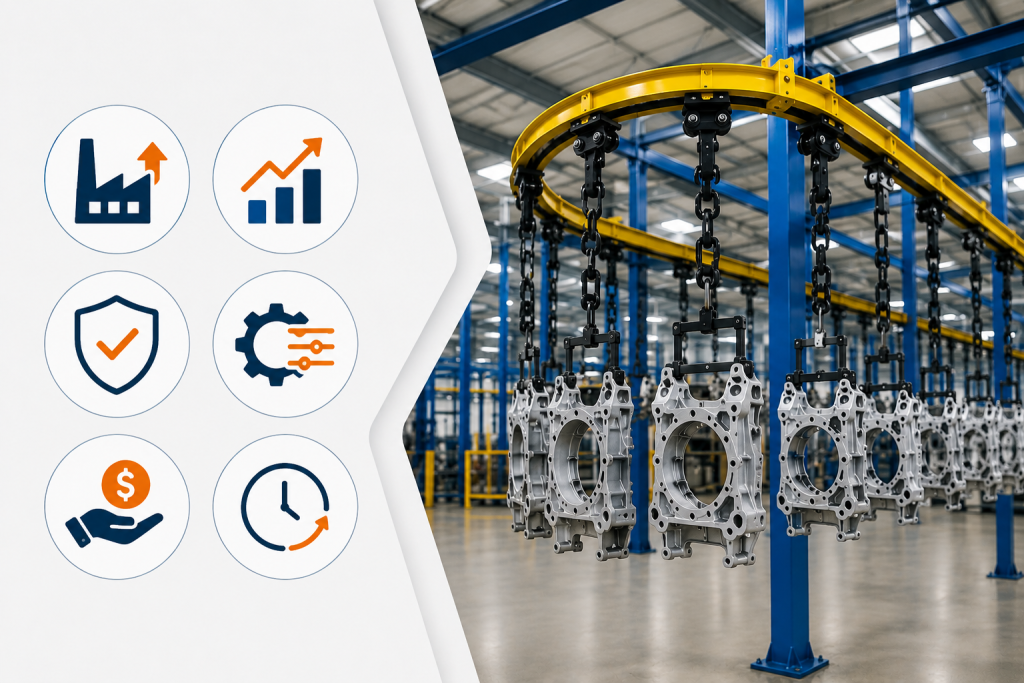
1. Maximum Floor Space Utilisation
By relocating material flow to the overhead space, factories reclaim valuable floor area for machinery, workstations, storage, and personnel. This is a decisive advantage in facilities where floor space is at a premium and expansion is not feasible. Unlike floor-level systems such as flat belt conveyors or gravity roller conveyors or powered roller conveyors, overhead systems leave the ground entirely clear.
2. Continuous, Uninterrupted Production Flow
Overhead conveyors enable a continuous loop of production movement. Parts and products can travel through multiple processes — cleaning, painting, drying, assembly, inspection — in a single, unbroken journey. This eliminates the need for manual transfers between stages, reduces handling time, and keeps production moving at a consistent pace.
3. Reduced Product Damage and Contamination
Suspending products overhead means they are not resting on surfaces that could scratch, dent, or contaminate them. In finishing operations especially, this all-round exposure ensures even coating and prevents surface defects caused by floor contact or manual handling.
4. Improved Worker Safety and Ergonomics
With material transport happening overhead, floor-level hazards from moving conveyors are significantly reduced. Workers operate in a safer environment without the risk of tripping over floor-mounted conveyor structures. Additionally, products can be positioned at an ergonomic working height as they pass through assembly or inspection stations, reducing operator fatigue and strain.
5. Flexible Routing Through Complex Layouts
Overhead conveyor tracks can be designed to follow virtually any path through a facility — including curves, inclines, declines, and switches that route carriers to different branches of the production process. This flexibility makes overhead systems suitable for complex factory layouts where floor-based conveyors would be impractical or obstructive.
6. Scalability and Long-Term Adaptability
Overhead conveyor systems can be extended, re-routed, or reconfigured as production requirements evolve. Additional tracks, switches, or spurs can be added without major facility modifications. This scalability makes them a sound long-term investment for growing manufacturing operations.
Choosing the Right Overhead Conveyor System
Selecting the appropriate overhead conveyor system requires careful evaluation of several factors:
Load weight and dimensions: Determines the structural capacity of the track, trolleys, and drive system required.
Production speed and throughput: Defines the motor specifications and carrier density needed to meet output targets.
Process requirements: Operations involving heat, chemicals, or paint overspray demand enclosed track systems with protected components.
Routing complexity: Facilities with multiple process zones or variable workstation dwell times benefit from power and free configurations.
Ceiling height and structure: The building’s structural capacity and available ceiling height must be assessed before installation.
A properly designed overhead conveyor integrates smoothly with floor-level systems such as assembly conveyors, modular belt conveyors, and slat conveyors to create a complete, end-to-end material handling ecosystem.
Why Choose Flexitech Engineering for Overhead Conveyor Systems?
Flexitech Engineering specialises in designing and manufacturing customised conveyor solutions for a wide range of industries across India. With extensive experience in overhead conveyor systems, Flexitech offers end-to-end project support — from initial layout planning and system design through to fabrication, installation, and commissioning.
Every overhead conveyor system designed by Flexitech is engineered to meet the specific load, speed, environment, and integration requirements of the client’s facility. Whether you operate an automotive plant, an appliance manufacturing unit, an electronics assembly facility, or a large distribution centre, Flexitech has the technical expertise to deliver a system that performs reliably, day after day.
Contact Flexitech Engineering today to discuss your overhead conveyor requirements and take the first step towards a more efficient, space-optimised production environment.